

Optics: Lecture 2 Light in Matter: The response of dielectric materials PowerPoint PPT Presentation
1 / 21
Title: Optics: Lecture 2 Light in Matter: The response of dielectric materials
1
Optics Lecture 2 Light in Matter The
response of dielectric materials
Dispersive Prism Dependence of the index of
refraction, n(?), on frequency or wavelength of
light.
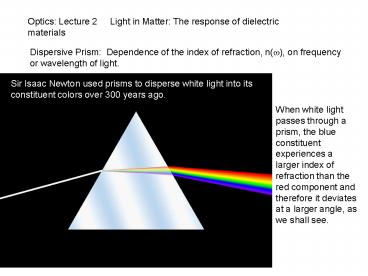
Sir Isaac Newton used prisms to disperse white
light into its constituent colors over 300 years
ago.
When white light passes through a prism, the blue
constituent experiences a larger index of
refraction than the red component and therefore
it deviates at a larger angle, as we shall see.
2
The effect of introducing a homogenous, isotropic
dielectric changes Maxwells equations to the
extent that ?o ? ? and ?o ? ?. The phase speed
in the medium becomes
The ratio of the speed of an E-M wave in vacuum
to that in matter is defined as the index of
refraction n
Relative Permittivity and Relative Permeability
For most dielectrics of interest that are
transparent in the visible, these are essentially
non-magnetic and to a good approximation KM ?
1.
3
To a good approximation also known as Maxwells
Relation
KE is presumed to be the static dielectric
constant (and works well only for some simple
gases, as shown on next slide). In reality, KE
and n are actually frequency-dependent, n(?),
known as dispersion.
Resonant process
Scattering and Absorption
m n
h?
- Non-resonant scattering
- Energy is lower than the resonant frequencies.
- E-M field drives the electron cloud into
oscillation - The oscillating cloud relative to the positive
nucleus creates an oscillating dipole that will
re-radiate at the same frequency.
Gas/Solids
Excitation energy can be transferred via
collisions before a photon is re-emitted.
4
Works well
Doesnt work so well
5
A small displacement x from equilibrium causes a
restoring force F.
F -kEx
and results in resonant frequency
x-axis
E(t)
-
Light ? E(t) and produces a classical forced
oscillator. Amplitude 10-17 m for bright sun
light.
6
The result can be modeled like a classical forced
oscillator with FE qeEocos(?t) qeE(t).
Using Newtons 2nd law Driving Force Restoring
Force ma, where Rest. Force -kEx
To solve, let x(t) xocos?t
Note that the phase of the displacement x
depends on ? gt ?o or ? lt ?o which gives x ? ?
qE(t).
7
The electric polarization or density of dipole
moments (dipole moment/vol.) is given by
Where N number electrons per volume.
We learn from the dielectric properties of solids
that Therefore
Since n2 KE ?/?o it follows that we obtain
the following dispersion equation
Note that ? gt ?o ? n lt 1 (above
resonance) (Displacement is 180? out-of-phase
with driving force.) and ? lt ?o ? n gt1 (below
resonance) (Displacement is in-phase with driving
force.)
8
Consider classically the average power (Pav)
delivered by the applied electric field
(See, e.g. Mechanics, Symon, 3rd Ed.)
Phase angle ?
This average power is analogous to absorption of
E-M radiation at the resonant frequency ?0.
9
For light ? ck 2?c/?, we can write the
dispersion relation as
Thus, if we plot (n2-1)-1 versus ?-2 we should
arrive at a straight line.
10
- In reality, there are several transitions in
which n gt 1 and n lt 1 for increasing ?, i.e.,
there are several ?oi resonant frequencies
corresponding to the complexity of the material. - Therefore, we generalize the above result for N
molecules/vol. with fj different oscillators
having natural frequencies ?oj, where j 1, 2,
3..
A quantum mechanical treatment shows further that
where fj are weighting factors known as Q.M.
oscillator strengths and represent the transition
probability for each mode j. The energy
is the energy of absorption or emission for a
given electronic, atomic, or molecular transition.
11
- When ? ?oj then n is discontinuous (and blows
up). Actual observations show continuity and
finite n. - The conclusion is that a damping force which is
proportional to the speed me?dx/dt should
generally be included when there are strong
interactions occurring between atoms and
molecules, such as in liquids and solids. - With damping, (1) energy is lost when oscillators
re-radiate and (2) heat is generated as a result
of friction between neighboring atoms and
molecules. - The corrected dispersion, including damping
effects, is as follows
This expression often works fine for gases.
12
- In a dense solid material, the atoms/molecules
may experience an additional field that is
induced by the surrounding medium and is given by
P(t)/3?o. - With this induced field, the dispersion relation
becomes
- We will see that a complex index of refraction
will lead to absorption. - Presently, we will consider regions of negligible
absorption in which n is real and - Thus
For various glasses, Since ?oj 100 nm in the
ultra-violet (UV).
13
- Note that as ? ? ?oj, n(?) gradually increases
and the behavior is called Normal Dispersion. - Again, at ? ?oj, n is complex and leads to an
absorption band. - Also, when dn/d? lt 0, the behavior is called
Anomalous Dispersion.
14
When white light passes through a glass prism,
the blue constituent experiences a larger index
of refraction than the red component and
therefore it deviates at a larger angle, as seen
in the first slide.
15
- Note the rise of n in the UV and the fall of n in
the IR, consistent with Normal Dispersion. - At even lower frequencies in the radio range, the
materials become again transparent with n gt 1. - Transparency occurs when ? ltlt ?o or ? gtgt ?o.
- When ? ?o, dissipation, friction and therefore
absorption occurs, causing the observed opacity.
16
(No Transcript)
17
Absorption Spectrum of Water Absorption
coefficient nI is the imaginary part of the
index of refraction.
18
The water vapor absorption bands are related to
molecular vibrations involving different
combinations of the water molecule's three
fundamental vibrational transitions V1
symmetric stretch mode V2 bending mode V3
asymmetric stretch mode The absorption feature
centered near 970 nm is attributed to a 2V1 V3
combination, the one near 1200 nm to a V1 V2
V3 combination, the one near 1450 nm to a V1 V3
combination, and the one near 1950 nm to a V2
V3 combination. In liquid water, rotations tend
to be restricted by hydrogen bonds, leading to
vibrations, or rocking motions. Also stretching
is shifted to a lower frequency while the bending
frequency increased by hydrogen bonding.
19
Propagation of Light, Fermats Principle (1657)
Involves the principle of least time The path
between two points that is taken by a beam of
light is the one that is transversed in the least
amount of time.
To find the path of least time, set dt/dx0.
Since ni c/vi and nt c/vt . Snells Law of
Refraction
20
where ?o is the vacuum wavelength.
Note that
In general, for many layers having different n,
we can write
Note that if the layers are very thin, we can
write
OPL (Optical Path Length)
21
We can compute t as simply Note that the
spatial path length is and for a medium
possessing a fixed index n1,
- Fermats principle can be re-stated Light in
going from S?P traverses the route having the
smallest OPL. - We will begin next with the E-M approach to light
waves incident at an interface and derive the
Fresnel Equations describing transmission and
reflection.
Recommended

