

Land Cover Mapping for the Southwest Regional GAP Analysis Project PowerPoint PPT Presentation
1 / 28
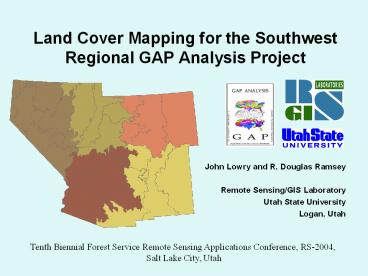
Title: Land Cover Mapping for the Southwest Regional GAP Analysis Project
1
Land Cover Mapping for the Southwest Regional GAP
Analysis Project
John Lowry and R. Douglas Ramsey Remote
Sensing/GIS Laboratory Utah State
University Logan, Utah
Tenth Biennial Forest Service Remote Sensing
Applications Conference, RS-2004, Salt Lake
City, Utah
2
Presentation Overview
- Project Background Objectives
- Mapping Methodology
- Training Data Collection Approach
- Current Status Preliminary Results
3
I. Project Background Objectives
- State-based vegetation classification systems
(cover type legends) - State-based mapping methods
- State-based mapping area
4
- 40 Mapping zones
- Spectrally consistent
- Eco-regionally distinct
- Labor divided among 5 state teams
5
Thematic Target LegendDeveloped with NatureServe
NatureServe Ecological Systems
NVC Formation
NVC Alliance
NVC Association
NVC Class/Subclass
1,800 units
10 units
5,000 units
700 units
300 units
MRLC 2000 Proposal
Gap Analysis Program
National Park Mapping
(Natural/Semi-natural types)
(Slide Courtesy Pat Comer, Nature Serve)
6
Ecological Systems
Groups of plant communities and sparsely
vegetated habitats unified by similar ecological
processes, substrates, and/or environmental
gradients...and spectral characteristics.
7
Predictor Datasets DEM derived
Landform
Elevation
8
Predictor Datasets Imagery Derived
July-Aug
Sept-Oct
ETM Bands 5, 4, 3
ETM Bands 5, 4, 3
9
II. Mapping Methods Classification Trees
- Data-mining software for decision-making and
exploratory data analysis - Identifies complex relationships between multiple
independent variables to predict a single
categorical class - Predictor variables may be categorical or
continuous - Recursively splits the predictor data to create
prediction rules or a decision tree. - Software packages available See5, SPLUS, CART
10
Mining the Predictor Layers
Imagery Landsat 7 ETM (1999-2002) for spring, summer fall
NDVI, SAVI, Brightness,Greeness, Wetness, Landsat 7 Bands
DEM Elevation, Aspect, Slope, Landform
Vector Geology, Soils
Meteorological DAYMET
11
(No Transcript)
12
Simplified Example Splits on 2 variables
13
Simplified Example Tree output for 2 variables
14
Example Rules Output
See5 Release 1.17 Wed Apr 23 134202
2003 Options Rule-based
classifiers Class specified by attribute
dep' Read 7097 cases (10 attributes) from
t3.data Rules Rule 1 (17, lift 45.4)
band01 1 band03 gt 115 band03
lt 122 band05 lt 81 band06 lt
1419 -gt class 1 0.947 Rule 2 (9,
lift 43.6) band01 1 band02 lt
102 band03 gt 115 band03 lt 118
band04 lt 117 band06 lt 1419
-gt class 1 0.909 Rule 3 (6, lift 42.0)
band01 13 band03 lt 110
band05 lt 73 band07 4
Generated with cubistinput by EarthSat
Training samples 10260 Validation samples
2565 Minimum samples 0 Sample method
Random Output format See5 dep. h/mgz
n_5/trainingdata/mrgpts1.img(Layer_1) Xcoord i
gnore. Ycoord ignore. band01 1,2,-30
h/mgzn_5/img_files/sum30cl.img(Layer_1) band02
continuous. h/mgzn_5/img_files/subrt.img(Layer
_1) band03 continuous. h/mgzn_5/img_files/sundv
i.img(Layer_1) band04 continuous. h/mgzn_5/img
_files/fandvi.img(Layer_1) band05 continuous. h
/mgzn_5/img_files/fabrt.img(Layer_1) band06 con
tinuous. h/mgzn_5/img_files/elev.img(Layer_1) b
and07 0,1,2,3,4,5,6,7,8,9,10. h/mgzn_5/img_file
s/landf.img(Layer_1) dep 1,2,3,4,5,6,7,8,9,10,
11,12,13,14,15,16,17,18,19,20. h/mgzn_5/training
data/mrgpts1
15
Multiple Tree Approaches
Boosting (iterative trees try to account for
previous trees errors)C5 Different
over-fitting issues associated with each tree
tend to be averaged out.
V O T E
(Slide Courtesy Bruce Wylie, USGS EDC)
16
Imagine CART Module (USGS Eros Data
Center)See5-Imagine Integration
17
III. Training Data Collection
Opportunistic, ground-based sampling, stratified
by digital landform model
18
Percent ground cover by dominant species is
recorded through ocular estimation. Only the top
4 species of each of 4 life forms are recorded
19
(No Transcript)
20
3000 Air Photo Interpretation Sites from USFS
Photos
21
Regional Total 93,000
22
IV. Current Status Preliminary Results
23
Edge-matching between three mapping areas
24
Accuracy Assessment with 20 withheld data
Considered correctly classified if majority of
pixels agree with sample polygon
25
Accuracy Assessment with 20 withheld data
Southern Wasatch Range
26
1995 GAP 30 M
2004 GAP 30 M
1995 GAP Pub.1KM
27
Summary
- Approximately 100 Ecological Systems and 10 NLCD
Land Use classes - Generalized to 1 acre MMU
- Delivered via NBII data node
- Anticipated completion 1 September, 2004
28
Acknowledgements
Recommended

