

How is language used differently in different situations? PowerPoint PPT Presentation
Title: How is language used differently in different situations?
1
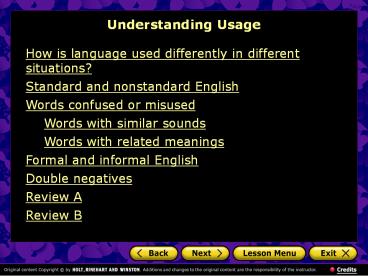
Understanding Usage
How is language used differently in different
situations? Standard and nonstandard
English Words confused or misused Words with
similar sounds Words with related meanings Formal
and informal English Double negatives Review
A Review B
2
How is language used differently in different
situations?
Most of us speak and write several languageseven
if we only know English.
You probably wouldnt talk to your coach the same
way you talk to a friend.
Your school essays probably dont look anything
like your text messages.
3
How is language used differently in different
situations?
We choose a language to suit our audience and
purpose.
Audiencethe person or people to whom you are
speaking or writing
Purposeyour reason for writing or speaking
End of Section
4
Standard and nonstandard English
American English is rich and varied, with many
distinct dialects. No dialect is better or more
correct than another.
Each ethnic dialect or regional dialect has its
own rules and unique features of grammar,
vocabulary, and pronunciation.
5
Standard and nonstandard English
An ethnic dialect may be used by people who share
the same cultural heritage.
Ethnic dialects sometimes use vocabulary and
grammar elements from other languages.
6
Standard and nonstandard English
The U.S. has four major regional dialects the
Northern, the Midland, the Southern, and the
Western.
Pronunciations and vocabulary vary from region to
region.
7
Standard and nonstandard English
The kind of English you are expected to use in
school and work situations is called standard
English.
We learn standard English so that we can
communicate with and understand people from
different regions and cultures.
8
Standard and nonstandard English
Standard English is
- grammatically correct
- appropriate in both formal and informal situations
- more widely used than any other variety of
American English
- more accepted than any other variety
9
Standard and nonstandard English
Nonstandard English is suitable in casual
speaking situations. It can also be used when you
are writing dialogue.
Nonstandard does not mean wrong. It means not
appropriate in situations where standard English
is expected.
End of Section
10
Words confused or misused Words with similar
sounds
In English, many words sound alike but are
spelled differently and have different meanings.
Its/its
Its is a contraction of it is or it has.
Its time to leave.
its it is
Its been a nice day.
its it has
Its is a possessive form that means belonging to
it.
The city must increase its water supply.
11
Words confused or misused Words with similar
sounds
The possessive forms of pronouns never have
apostrophes, even when the form ends in s.
Grammar Gal Says...
hers The red bike is hers.
yours Whats mine is yours.
ours Ours is the cleanest car.
theirs Has theirs arrived yet?
its The horse raised its head.
12
Words confused or misused Words with similar
sounds
Its/its
I might buy this car. Its in good condition, and
its engine is reliable.
13
Words confused or misused Words with similar
sounds
Theyre/there/their
Theyre is a contraction of they are.
Theyre playing jazz music.
There is an adverb that means at that place.
There is also used to begin a sentence.
Did you get there on time?
at that place
There will be a crowd at the mall.
begins sentence
14
Words confused or misused Words with similar
sounds
Theyre/there/their
Their is the possessive form of they, meaning
belonging to them.
Did they make their own costumes?
15
Words confused or misused Words with similar
sounds
Theyre/there/their
Right there is the shop where theyre having
their bikes repaired.
16
Words confused or misused Words with similar
sounds
Youre/your
Youre is a contraction of you are.
Youre not angry, are you?
Your is the possessive form of you, meaning
belonging to you.
Does your brother go to college?
17
Words confused or misused Words with similar
sounds
Youre/your
When youre done cooking, please clean up your
mess.
18
Words confused or misused Words with similar
sounds
Whos/whose
Whos is a contraction of who is or who has.
Whos the new math teacher?
whos who is
Whos been tutoring you?
whos who has
Whose is the possessive form of who, meaning
belonging to whom.
Whose bracelet is this?
19
Words confused or misused Words with similar
sounds
Whos/whose
Whos the player whose hand was injured?
20
Words confused or misused Words with similar
sounds
Accept/except
Accept is a verb that means to receive.
Did you accept the gift?
Except is usually a preposition that means
excluding. Less often, it is a verb that means
to leave out.
preposition
Everyone except Kyle stayed.
Mrs. Liu will not except anyone from the deadline.
verb
21
Words confused or misused Words with similar
sounds
Could of/ought to of/should of
Of is a preposition. Do not use of in place of
have after verbs such as could, should, would,
might, must, and ought to.
You should of come over.
You should have come over.
We could of played darts.
We could have played darts.
You ought to of asked me earlier.
You ought to have asked me earlier.
22
Words confused or misused Words with similar
sounds
The reason people sometimes write could of is
that they are thinking about the contraction
couldve.
Grammar Gal Says...
couldve could have
shouldve should have
wouldve would have
23
Words confused or misused Words with similar
sounds
For each sentence, choose the correct word or
words in parentheses.
1. The snake is shedding (its, its) skin.
2. Juanita (excepted, accepted) the invitation.
3. They left (their, there) luggage downstairs.
4. Call me when (your, youre) ready to leave.
5. (Whose, Whos) singing the solo?
24
Words confused or misused Words with similar
sounds
For each sentence, choose the correct word or
words in parentheses.
1. The snake is shedding (its, its) skin.
Its is the possessive form of it The snake is
shedding the skin that belongs to it.
25
Words confused or misused Words with similar
sounds
For each sentence, choose the correct word or
words in parentheses.
2. Juanita (excepted, accepted) the invitation.
Accept is a verb that means to receive.
26
Words confused or misused Words with similar
sounds
For each sentence, choose the correct word or
words in parentheses.
3. They left (their, there) luggage downstairs.
Their is the possessive form of they They left
the luggage that belonged to them.
27
Words confused or misused Words with similar
sounds
For each sentence, choose the correct word or
words in parentheses.
4. Call me when (your, youre) ready to leave.
Youre is the contraction of you are Call me
when you are ready to leave.
28
Words confused or misused Words with similar
sounds
For each sentence, choose the correct word or
words in parentheses.
5. (Whose, Whos) singing the solo?
Whos is the contraction of who isI Who is
singing?
29
Words confused or misused Words with similar
sounds
On Your Own
Some of the following sentences contain errors in
the use of standard English. Find and correct
each error. If a sentence is already correct,
label it C. 1. Its a great day for flying a
kite. 2. Did they say where theyre going for
vacation? 3. I should of spent more time
practicing free throws. 4. The dog is chewing
its bone. 5. Whose glasses are lying on youre
desk? 6. All the actors knew there parts except
Jeff.
End of Section
30
Words confused or misused Words with similar
sounds
Some of the following sentences contain errors in
the use of standard English. Find and correct
each error. If a sentence is already correct,
label it C. 1. Its a great day for flying a
kite. 2. Did they say where theyre going for
vacation? 3. I should of spent more time
practicing free throws. 4. The dog is chewing
its bone. 5. Whose glasses are lying on youre
desk? 6. All the actors knew there parts except
Jeff.
Its
C
have
C
your
their
31
Words confused or misused Words with related
meanings
Some pairs of words are confused because their
meanings are so close to each other.
Bring/take
Bring means to come carrying something.
Please bring me the broom.
Take means to go carrying something.
Now take it back to the closet.
32
Words confused or misused Words with related
meanings
Fewer/less
Fewer is used with plural nouns.
Jared worked fewer hours this week than last week.
plural noun
Less is used with singular nouns.
Jared worked less time this week than last week.
singular noun
Fewer tells how many. Less tells how much.
33
Words confused or misused Words with related
meanings
Good/well
Good is always an adjective. Do not use good to
modify a verb. Use the adverb well.
Adj.
Ernesto makes good salads.
Noun
Adverb
He and his sister both cook well.
Verb
34
Words confused or misused Words with related
meanings
Good/well
Well is usually an adverb that means capably,
but it is also used as an adjective to mean
healthy.
Adj.
Adverb
Bret feels well today.
Bret played well.
Verb
Noun
adverb meaning capably
adjective meaning healthy
35
Words confused or misusedWords with related
meanings
Feel good and feel well have different meanings.
Feel good means to feel happy or pleased. Feel
well means to feel healthy.
Grammar Gal Says...
I feel good whenever I volunteer.
If you dont feel well, you should go home.
36
Words confused or misused Words with related
meanings
For each sentence, choose the correct word in
parentheses, according to standard usage.
1. Will you (bring, take) your first-aid kit when
you go camping?
2. Mike didnt play as (good, well) today as he
usually does.
3. One of the mayors goals is to have (fewer,
less) pets entering the city shelter.
37
Words confused or misused Words with related
meanings
For each sentence, choose the correct word in
parentheses, according to standard usage.
1. Will you (bring, take) your first-aid kit when
you go camping?
Take means to go carrying something.
38
Words confused or misused Words with related
meanings
For each sentence, choose the correct word in
parentheses, according to standard usage.
2. Mike did not play as (good, well) today as he
usually does.
Well is an adverb that means capably. In this
sentence, well modifies the verb did play.
39
Words confused or misused Words with related
meanings
For each sentence, choose the correct word in
parentheses, according to standard usage.
3. One of the mayors goals is to have (fewer,
less) pets entering the city shelter.
Fewer should be used with the plural noun pets.
40
Words confused or misused Words with related
meanings
On Your Own
Some of the following sentences contain errors in
the use of standard English. Find and correct
each error. If a sentence is already correct,
label it C. 1. Matt always feels good when he
helps someone. 2. This tree has less apples than
that one. 3. When you go to the game, please
bring your sister with you. 4. The debate team
performed good at the tournament.
End of Section
41
Words confused or misused Words with related
meanings
Some of the following sentences contain errors in
the use of standard English. Find and correct
each error. If a sentence is already correct,
label it C. 1. Matt always feels good when he
helps someone. 2. This tree has less apples than
that one. 3. When you go to the game, please
bring your sister with you. 4. The debate team
performed good at the tournament.
C
fewer
take
well
42
Formal and informal English
The term formal English is used for language that
is appropriate in serious speaking and writing
situations.
Please relax.
Chill out, would ya?
Informal English indicates standard usage that is
common in conversations and everyday writing,
such as personal letters.
Oh, that is terrific!
Thats way cool!
43
Formal and informal English
Speeches at ceremonies
Formal English expected
Serious papers, reports
Tests and exams
Business letters and interviews
Everyday conversations
Informal English okay
Personal letters, e-mails
Journal entries
Some newspaper and magazine writing
44
Formal English
Informal English
Formal and informal English
- Sentence structure
- shorter
- simpler
- Word choice
- simple
- colloquialisms, slang, contractions
- Tone
- conversational
- Sentence structure
- longer
- more complex
- Word choice
- precise
- sometimes technical or scientific
- Tone
- serious, dignified
45
Formal and informal English
Colloquialisms are the informal words and phrases
of everyday speech that add flavor and color to
our language.
Many colloquialisms are figures of speech that
arent meant to be taken literally.
I dont want to argue, so lets bury the hatchet.
With time to kill, Joan flipped through a
magazine.
46
Formal and informal English
Slang is made up of new words or old words used
in new ways. Slang is usually clever or colorful.
Slang is often a special language in a specific
group, such as students or military personnel.
Slang words usually have a short life, but some
last and become widely used.
bummerdisappointment
lameweak, pathetic
coolneat, fun
47
Formal and informal English
Many words and phrases that are fine in informal
situations should be avoided in formal
situations.
How come
In formal situations, use why.
How come you overslept?
Informal
Why did you oversleep?
Formal
48
Formal and informal English
Kind of/sort of
In formal situations, use rather or somewhat.
You seem kind of nervous.
Informal
You seem somewhat nervous.
Formal
49
Formal and informal English
Try and
In formal situations, use try to.
Do not try and shovel all that snow at once.
Informal
Formal
Do not try to shovel all that snow at once.
50
Formal and informal English
Tell whether the following sentences use
informal (I) or formal (F) language. If the
language is informal, provide the formal
alternative.
1. Fred was rather disappointed with his grade.
2. How come you didnt go to practice?
3. Please try and be on time for the field trip.
4. The roads are still kind of icy.
51
Formal and informal English
Tell whether the following sentences use
informal (I) or formal (F) language. If the
language is informal, provide the formal
alternative.
1. Fred was rather disappointed with his grade.
F
Rather is formal.
52
Formal and informal English
Tell whether the following sentences use
informal (I) or formal (F) language. If the
language is informal, provide the formal
alternative.
2. How come you didnt go to practice?
I
How come is informal. In formal situations, use
why.
53
Formal and informal English
Tell whether the following sentences use
informal (I) or formal (F) language. If the
language is informal, provide the formal
alternative.
3. Please try and be on time for the field trip.
I
Try and is informal. In formal situations, use
try to.
54
Formal and informal English
Tell whether the following sentences use
informal (I) or formal (F) language. If the
language is informal, provide the formal
alternative.
4. The roads are still kind of icy.
I
Kind of is informal. In formal situations, use
rather or somewhat.
55
Formal and informal English
On Your Own
Revise each sentence, changing the informal usage
to formal, standard usage. If a sentence is
correct, label it C. 1. It has been sort of
humid all week. 2. She tried to eat the whole
cookie in one bite. 3. How come Leila had to buy
all the decorations for the party? 4. Caleb has
decided to try and go to the same college as his
sister.
End of Section
56
Formal and informal English
Revise each sentence, changing the informal usage
to formal, standard usage. 1. It has been rather
humid all week. It has been somewhat humid all
week. 2. She tried to eat the whole cookie in
one bite. C 3. Why did Leila have to buy all the
decorations for the party? 4. Caleb has decided
to try to go to the same college as his sister.
57
Double negatives
In a double negative, two or more negative words
are used when only one is needed.
Negative 1
I havent never seen such a big pumpkin.
I havent never seen such a big pumpkin.
Incorrect
Negative 2
Double negatives often occur when not is part of
a contraction.
58
Double negatives
Common Negative Words Common Negative Words Common Negative Words
barely no not (nt)
hardly nobody nothing
neither none nowhere
never no one scarcely
59
Double negatives
To fix a double negative, change either of the
negative words.
Negative
Negative
Marc didnt buy nothing at the mall.
Incorrect
Marc didnt buy anything at the mall.
Correct
OR
Marc bought nothing at the mall.
60
Double negatives
To fix a double negative containing barely,
hardly, or scarcely, delete not or nt.
Negative
Negative
The puppy couldnt hardly walk.
Incorrect
The puppy couldnt hardly walk.
The puppy could hardly walk.
Correct
61
Double negatives
But and only are negative words when they mean
no more than. In such cases, using another
negative word with but or only is considered
informal.
Grammar Gal Says...
I could not help but laugh.
Informal
I could not help laughing.
Formal
62
Double negatives
Tell whether each sentence contains a double
negative (D) or is correctly written (C). If the
sentence contains a double negative, identify
both negative words.
1. We didnt bring no extra food with us.
2. Do not touch nothing on my desk!
3. Nothing I could say now would make any
difference.
4. Lou couldnt hardly keep from smiling.
63
Double negatives
Tell whether each sentence contains a double
negative (D) or is correctly written (C). If the
sentence contains a double negative, identify
both negative words.
1. We didnt bring no extra food with us.
D
1Not is a part of the contraction didnt.
2No is a negative word.
64
Double negatives
Tell whether each sentence contains a double
negative (D) or is correctly written (C). If the
sentence contains a double negative, identify
both negative words.
D
2. Do not touch nothing on my desk!
1Not is a negative word. 2Nothing is a
negative word.
65
Double negatives
Tell whether each sentence contains a double
negative (D) or is correctly written (C). If the
sentence contains a double negative, identify
both negative words.
3. Nothing I could say now would make any
difference.
C
This sentence contains only one negative word
nothing.
66
Double negatives
Tell whether each sentence contains a double
negative (D) or is correctly written (C). If the
sentence contains a double negative, identify
both negative words.
4. Lou couldnt hardly keep from smiling.
D
1Not is a part of the contraction couldnt.
2Hardly is a negative word.
67
Double negatives
On Your Own
- Correct the double negative in each sentence.
- Tom didnt have no time to buy the books.
- Didnt none of you see the dog?
- The light was so dim we couldnt barely see.
- 4. She hadnt never tasted papaya before.
End of Section
68
Double negatives
- Correct the double negative in each sentence.
- Tom had no time to buy the books. Tom didnt
have any time to buy the books. - Didnt any of you see the dog?Did none of you
see the dog? - The light was so dim we could barely see.
- 4. She had never tasted papaya before.She hadnt
ever tasted papaya before.
69
Review A
For each sentence, choose the correct word in
parentheses, according to formal, standard
usage. 1. Will you (bring, take) this book to
Jonah when you go to his house? 2. You must
learn to (accept, except) criticism graciously.
3. The waves look (kind of, rather) high this
morning. 4. (Whos, Whose) car is parked out
front? 5. The horse behaves (good, well) when we
brush (its, its) mane. 6. Judy is going to
(try and, try to) play tennis today.
End of Section
70
Review A
For each sentence, choose the correct word in
parentheses, according to formal, standard
usage. 1. Will you (bring, take) this book to
Jonah when you go to his house? 2. You must
learn to (accept, except) criticism graciously.
3. The waves look (kind of, rather) high this
morning. 4. (Whos, Whose) car is parked out
front? 5. The horse behaves (good, well) when we
brush (its, its) mane. 6. Judy is going to
(try and, try to) play tennis today.
71
Review B
Revise each sentence to make it correct according
to formal, standard usage. 1. Did Jim ever
explain how come he was so late? 2. It didnt
hardly rain at all last night. 3. You will make
less mistakes if you are more careful. 4. There
Great Dane is taller than youre Irish Wolfhound.
5. Randy doesnt take no shortcuts when he
writes a paper. 6. Kevin should of asked more
politely.
End of Section
72
Review B
Revise each sentence to make it correct according
to formal, standard usage. 1. Did Jim ever
explain how come he was so late? 2. It didnt
hardly rain at all last night. 3. You will make
less mistakes if you are more careful. 4. There
Great Dane is taller than youre Irish Wolfhound.
5. Randy doesnt take no shortcuts when he
writes a paper. 6. Kevin should of asked more
politely.
why
rained
fewer
Their
your
any
have
73
The End
Recommended

