

Effects of reproductive condition on HPG-HPA axis interaction PowerPoint PPT Presentation
1 / 1
Title: Effects of reproductive condition on HPG-HPA axis interaction
1
Effects of reproductive condition on HPG-HPA
axis interaction
Rosemary Hohnen and Ashley Edwards, School of
Zoology, UTAS
Background In vertebrates, activation of the
stress response (HPA axis) often results in the
down regulation of processes not immediately
necessary for that individuals survival
including reproduction (HPG axis) (Dong et al.
2004, DeNardo and Sinervo 1994). Furthermore,
some species with only a short season in which to
breed exhibit the ability to down regulate their
stress response, so as to prevent the inhibition
of reproduction (Wingfield et al. 1995). We
investigated in male blotched blue-tongue
lizards, Tiliqua nigrolutea, how the stress
response simulated by an ACTH injection alters
testosterone (T) and corticosterone (b)
concentrations during the breeding season in
spring, and reproductive quiescence in summer.
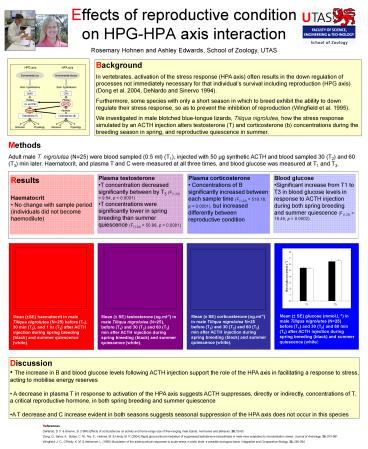
Methods Adult male T. nigrolutea (N25) were
blood sampled (0.5 ml) (T1), injected with 50 µg
synthetic ACTH and blood sampled 30 (T2) and 60
(T3) min later. Haematocrit, and plasma T and C
were measured at all three times, and blood
glucose was measured at T1 and T3.
- Plasma corticosterone
- Concentrations of B significantly increased
between each sample time (F(1,24) 518.18, p lt
0.0001), but increased differently between
reproductive condition
- Plasma testosterone
- T concentration decreased significantly between
by T3 (F(1,24) 9.54, p lt 0.0001) - T concentrations were significantly lower in
spring breeding than summer quiescence (F(1,24)
50.98, p lt 0.0001)
- Blood glucose
- Significant increase from T1 to T3 in blood
glucose levels in response to ACTH injection
during both spring breeding and summer quiescence
(F(1,25) 19.45, p 0.0002)
- Results
- Haematocrit
- No change with sample period (individuals did
not become haemodilute)
Mean (SE) haematocrit in male Tiliqua nigrolutea
(N25) before (T1), 30 min (T2), and 1 hr (T3)
after ACTH injection during spring breeding
(black) and summer quiescence (white).
- Discussion
- The increase in B and blood glucose levels
following ACTH injection support the role of the
HPA axis in facilitating a response to stress,
acting to mobilise energy reserves - A decrease in plasma T in response to activation
of the HPA axis suggests ACTH suppresses,
directly or indirectly, concentrations of T, a
critical reproductive hormone, in both spring
breeding and summer quiescence - A T decrease and C increase evident in both
seasons suggests seasonal suppression of the HPA
axis does not occur in this species
References DeNardo, D. F. Sinervo, B. (1994)
Effects of corticosterone on activity and
home-range size of free-ranging male lizards.
Hormones and Behavior, 28, 53-65. Dong, Q.,
Salva, A., Sottas, C. M., Niu, E., Holmes, M.
Hardy, M. P. (2004) Rapid glucocorticoid
mediation of suppressed testosterone biosynthesis
in male mice subjected to immobilization stress.
Journal of Andrology, 25, 973-981. Wingfield, J.
C., O'Reilly, K. M. Astheimer, L. (1995)
Modulation of the adrenocortical responses to
acute stress in arctic birds a possible
ecological basis. Integrative and Comparative
Biology, 35, 285-294.
Recommended

