

Computer science education for elementary school students: Curriculum development and implementation PowerPoint PPT Presentation
1 / 1
Title: Computer science education for elementary school students: Curriculum development and implementation
1
Computer science education for elementary school
students Curriculum development and
implementation
Department of Computer Science and Engineering,
Indian Institute of Technology, Mumbai
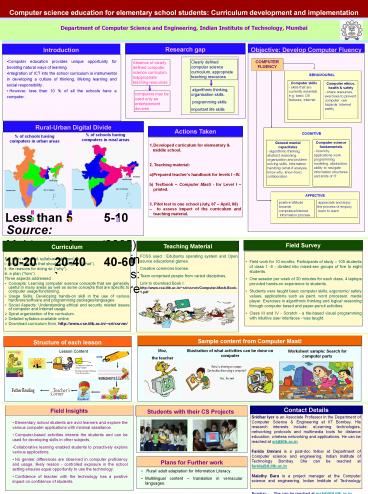
Research gap
Introduction
Objective Develop Computer Fluency
- Computer education provides unique opportunity
for boosting natural ways of learning. - Integration of ICT into the school curriculum is
instrumental in developing a culture of thinking,
lifelong learning and social responsibility . - However, less than 10 of all the schools have
a computer.
COMPUTER FLUENCY
Clearly defined computer science curriculum,
appropriate teaching resources
Absence of clearly defined computer science
curriculum, inappropriate teaching resources
BEHAVIOURAL
Computer skills - skills that are currently
essential, e.g. basic OS features, Internet.
- Computer ethics, health safety
- share resources, exercises to prevent
- computer use hazards, Internet safety.
algorithmic thinking, organisation skills.
programming skills important life skills
computers may be used only as entertainment
devices
Rural-Urban Digital Divide
Actions Taken
COGNITIVE
of schools having computers in rural areas
of schools having computers in urban areas
- Developed curriculum for elementary
- middle school.
- 2. Teaching material
- Prepared teachers handbook for levels I IV.
- b) Textbook Computer Masti - for Level I
printed. - 3. Pilot test in one school (July, 07 April,
08) - to assess impact of the curriculum and
teaching material.
Computer science fundamentals - how/why
applications work, programming, modeling,
abstraction, ability to navigate information
structures and limits of IT.
General mental capacitates - algorithmic
thinking, abstract reasoning, organization and
problem solving skills, information handling
(what-if analysis, know-why, know-how),
collaboration
AFFECTIVE
appreciate and enjoy the process of enquiry,
learn to learn
positive attitude towards computers/Internet,
information process
Less than 5 5-10 10-20 20-40 40-60
Source Mehta, A. (2005). Elementary education in
rural/urban areas Analytic tables. Where do we
stand?
Field Survey
Curriculum
Teaching Material
- Field work for 10 months. Participants of study
105 students of class 1 -5 - divided into
mixed-sex groups of five to eight students. - One session per week of 30 minutes for each
class, 4 laptops provided hands-on experience to
students. - Students were taught basic computer skills,
ergonomic/ safety values, applications such as
paint, word processor, media player. Exercises in
algorithmic thinking and logical reasoning
through computer based and paper-pencil
activities. - Class III and IV - Scratch - a tile-based visual
programming with intuitive user interfaces - was
taught.
- For each standard, syllabus is defined by
- i. giving the topics that should be taught
(what). - ii. the reasons for doing so (why).
- iii. a plan (how).
- Three aspects addressed
- Concepts Learning computer science concepts that
are generally useful in many areas as well as
some concepts that are specific to computer
usage/functioning. - Usage Skills Developing hands-on skill in the
use of various hardware/software and programming
packages/languages. - Social Aspects Understanding ethical and
security related issues of computer and Internet
usage. - Spiral organization of the curriculum.
- Detailed syllabus available online.
- Download curriculum from http//www.cse.iitb.ac.i
n/sri/ssrvm/
FOSS used Edubuntu operating system and Open
source educational games. Creative commons
license. Team comprised people from varied
disciplines. Link to download Book I
http//www.cse.iitb.ac.in/sri/ssrvm/Computer-Mast
i-Book-1.pdf
Sample content from Computer Masti
Structure of each lesson
Moz, the teacher
Illustration of what activities can be done on
computer
Worksheet sample Search for computer parts
Field Insights
Contact Details
Students with their CS Projects
Sridhar Iyer is an Associate Professor in the
Department of Computer Science Engineering at
IIT Bombay. His research interests include
eLearning technologies, networking protocols and
multimedia tools for distance education, wireless
networking and applications. He can be reached at
sri_at_iitb.ac.in Farida Umrani is a post-doc
fellow at Department of Computer science and
engineering, Indian Institute of Technology
Bombay. She can be reached at farida_at_it.iitb.ac.in
Malathy Baru is a project manager at the
Computer science and engineering, Indian
Institute of Technology Bombay. She can be
reached at malati_at_it.iitb.ac.in
- Elementary school students are avid learners and
explore the various computer applications with
minimal assistance. - Computer-based activities interest the students
and can be used for developing skills in other
subjects. - Collaborative learning enabled students to
proactively explore various applications. - No gender differences are observed in computer
proficiency and usage, likely reason - controlled
exposure in the school setting ensures equal
opportunity to use the technology. - Confidence of teacher with the technology has a
positive impact on confidence of students.
Plans for Further work
- Rural/ adult adaptation for Information
Literacy. - Multilingual content translation in vernacular
languages.
Recommended

