

Laboratory Exercise Weather Station Instrument Performance Characterization and Calibration PowerPoint PPT Presentation
1 / 14
Title: Laboratory Exercise Weather Station Instrument Performance Characterization and Calibration
1
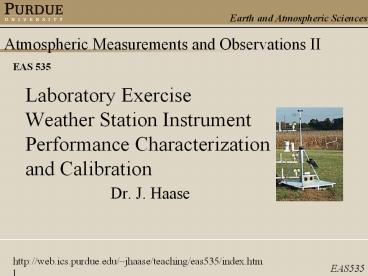
Laboratory ExerciseWeather Station Instrument
Performance Characterization and Calibration
Atmospheric Measurements and Observations II
EAS 535
- Dr. J. Haase
http//web.ics.purdue.edu/jhaase/teaching/eas535/
index.html
2
Class Objectives
- Gain experience and familiarity with surface
meteorological equipment - Understand components of an observation system
- Understand how to verify data quality
- Analyze data to check for random and systematic
errors
3
Vaisala MAWS weather station
4
Davis Weather Monitor II Weather Station
- Inside temperature 32F to 140F
- Outside temperature from - 50F to 140F
- High and low temperature memory with time and
date stamp and alarms - Wind speed and direction in 1 or 10 degree
increments with wind speed to 175mph, wind speed
memory with date and time stamp and alarms - Barometric pressure, with memory and alarms, and
trend arrow. - Pressure from 26 to 32 inches of mercury
- Humidity inside 10 to 90, outside 0 to 100
- Dew point from -99F to 140F with high and low
memory and alarms
5
Instrument model
Temperature of air
?T deg c deg/volt ?V volts
6
Characterize errors
- Temperature error
- Relative humidity error
- Pressure error
- Use the MAWS sensor as the reference
- For example
- Terror_tm02 Tobserved_tm02-TMAWS
7
Systematic Errors
- BIAS a sensor measures a parameter with an
average constant offset compared to a reference
measurement. - calibration DRIFT over timee.g. the sensor
measures a parameter more accurately at the
beginning of the period than at the end of the
period. - CONTAMINATION by another environmental variable
in this case, a parameter error may be correlated
with another measured value, for example
contamination by heating by direct sunlight. - NONLINEARITY the linear relationship assumed in
a calibration equation is not correct. This will
typically be manifested as an error that is a
smooth function of the reference or true value,
and would be evident in a plot, for example, of
dT verus T. - TIME LAGGED RESPONSE the error is due to the
sensor not responding to the most rapid
fluctuations in the actual parameter, so the
measured parameter appears as a smoothed version
of the reference or true parameter. This will
usually be most obvious in the comparison of the
raw time series with the true value or reference
value.
8
Interpretation
- Which parameters and which instruments, if any,
seem to show RANDOM errors? - SYSTEMATIC BIAS errors?
- SYSTEMATIC DRIFT errors?
- SYSTEMATIC CONTAMINATION errors and what might be
the source of the contamination? - SYSTEMATIC NONLINEARITY errors?
- SYSTEMATIC TIME LAGGED RESPONSE errors?
- Which instruments would you tend to recommend as
giving the most precise measurements? - What are the possible sources of the major
errors? - When answering these questions, refer to the
graphs that you have created in the previous
parts of the exercise. In some cases, the answer
might be none. - Also refer to instrument specifications, lab
notebooks, and notes on experimental setup
9
Examples from last years data
10
Time lagged response
- Plot parameters versus time
- Time error due to clock offset?
- Different response times for different instrument
type
11
Contamination
- Plot parameter versus time of day
- Overlap several days of data
12
Bias
- Plot residual (observation minus reference)
versus time - Average offset is bias is it a calibration
error? - Diurnal contamination error?
13
Nonlinearity
- Plot residual as a function of the reference
parameter
14
Correlation
- Plot one parameter versus the reference parameter
Recommended

