

Global changes in Staphylococcus aureus gene expression during human prosthetic joint infection PowerPoint PPT Presentation
1 / 1
Title: Global changes in Staphylococcus aureus gene expression during human prosthetic joint infection
1
Global changes in Staphylococcus aureus gene
expression during human prosthetic joint infection
Yijuan Xu1, Raluca Georgiana Maltesen1, Lone
Heimann Larsen1,2, Henrik Carl Schønheyder2,
Jeppe Lund Nielsen1, Per Halkjær Nielsen1, Trine
Rolighed Thomsen1,3, Kåre Lehmann Nielsen1, The
PRIS Study Group3 1Department of Biotechnology,
Chemistry, and Environmental Engineering, Aalborg
University, Denmark. 2Department of Clinical
Microbiology, Aalborg Hospital, Aalborg
University Hospital, Denmark. 3The Danish
Technological Institute, Life Science Division,
Denmark.
AAU
C o n c l u s i o n s
I n t r o d u c t i o n
- S. aureus sustained on a versatile
human-cell-based diet consisting of amino acids,
glycans and nucleosides in the hypoxic joint
fluid during human prosthetic joint infection. - Many, but not all, of the known virulence factor
genes were upregulated in situ.
Staphylococcus aureus is one of the leading
causes of community- and hospital-acquired
infections worldwide. It can cause acute
infections and adapt to a biofilm mode of growth
and thereby cause persistent and recurrent
infections, particularly in device-related
infections. Little is known about regulation of
gene activity of S. aureus during actual human
infection. Here we characterize the metabolome
using NMR, and the transcriptome using RNA-seq,
of S. aureus infected joint fluid derived from an
acute human prosthetic joint infection, and
compare them with the genome, transcriptome and
metabolome of an isolate obtained from the same
sample grown in vitro (LB medium).
R e s u l t s
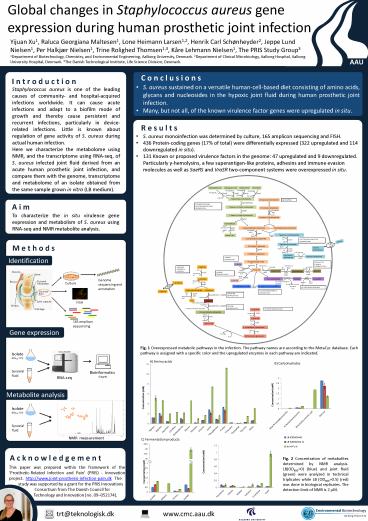
- S. aureus monoinfection was determined by
culture, 16S amplicon sequencing and FISH. - 436 Protein-coding genes (17 of total) were
differentially expressed (322 upregulated and 114
downregulated in situ). - 131 Known or proposed virulence factors in the
genome 47 upregulated and 9 downregulated.
Particularly ?-hemolysins, a few
superantigen-like proteins, adhesins and immune
evasion molecules as well as SaeRS and VraSR
two-component systems were overexpressed in situ.
Thymidine
Deoxyguanosine
Deoxyuridine
Deoxyadenosine
Phosphate
Phosphate
Phosphate
Phosphate
DeoD
DeoD
DeoA
DeoA
Guanine
Uracil
Thymine
Adenine
Deoxyribose-1-phosphate
ß-D-glucose-6-phosphate
GLYCOLYSIS I
A i m
Spontaneous
PURINE/PYRIMIDINE DEOXYRIBONUCLEOSIDES
DEGRADATION
2-Deoxy-a-D-ribose 1-phosphate
D-fructose-6-phosphate
Phosphate
DeoB
fbp
To characterize the in situ virulence gene
expression and metabolism of S. aureus using
RNA-seq and NMR metabolite analysis.
H2O
2-Deoxy-D-ribose-5-phosphate
Fructose-1,6-bisphosphate
DeoC
Acetaldehyde
NAD Coenzyme A
AldA ADH
Dihydroxyacetone phosphate
D-glyceraldehyde-3-phophate
Phosphate NAD
NADH H
gapA
H NADH
Tagatose-1,6-bisphosphate
Acetyl-CoA
LacD
ADP H
1,3-Bisphospho-D-glycerate
LACTOSE AND GALACTOSE DEGRADATION I
LacC
Lactose
M e t h o d s
ATP
LacE LacF
Tagatose-6-phosphate
3-Phospho-D-glycerate
NAD
Lactose 6-phosphate
Coenzyme A
LacA LacB
gpmA
H NADH
b-D-glucose
2-Phospho-D-glycerate
H2O
D-galactose 6-phosphate
Lactose 6-phosphate
Identification
L-SERINE DEGRADATION
LacG
Phosphoenolpyruvate
PYRUVATE TO ETHANOL FERMENTATION I
L-serine
H ammonia
Coenzyme A
Coenzyme A
L-arginine
formate
NAD
ARGININE DEIMINASE PATHWAY
H
H
NAD
NADH
tdcB
NADH
Pyruvate
H2O
Acetyl-CoA
Ethanol
NADH Ammonia 2 H
Acetaldehyde
ADH adhP
pflB
arcA
ALANINE DEGRADATION IV
aldA ADH
Ammonia H
NAD H2O
ald
butA
Spontaneous
(S)-2-acetolactate
Diacetyl
(S)-acetoin
Genome sequencing and annotation
L-citrulline
L-alanine
Phosphate H
An oxidized electron acceptor H
argI argF
Culture
L-ornithine
NADH H
NAD
A reduced electron acceptor CO2
arcD
N-acetylneuraminate
N-acetyl-ß-D-mannosamine
nanA
(S)-ACETOIN BIOSYNTHESIS
Carbamoyl-phosphate
L-ornithine
N-ACETYLNEURAMINATE DEGRADATION
L-arginine
ADP H
yqeA arcC
ORNITHINE DEGRADATION I
SAUREUSv1_20053
Ammonia ATP
Ammonium
CO2
L-proline
FISH
An oxidized electron acceptor
SAUREUSv1_30035
PROLINE DEGRADATION
H A reduced electron acceptor
HISTIDINE DEGRADATION I
L-histidine
(S)-1-pyrroline-5-carboxylate
hutH
Ammonia H
2 H2O NAD
rocA
Urocanate
H NADH
16S amplicon sequencing
H2O
hutU
L-glutamate
H
4-Imidazolone-5-propionate
Gene expression
H2O H
hutU
Formate
N-forminino-L-glutamate
H2 O
Fig. 1 Overexpressed metabolic pathways in the
infection. The pathway names are according to the
MetaCyc database. Each pathway is assigned with a
specific color and the upregulated enzymes in
each pathway are indicated.
Metabolite analysis
NMR measurement
A c k n o w l e d g e m e n t
This paper was prepared within the framework of
the Prosthetic-Related Infection and Pain
(PRIS) - Innovation project. http//www.joint-pro
sthesis-infection-pain.dk The study
was supported by a grant for the PRIS Innovations
Consortium from The Danish Council for
Technology and Innovation (no. 09052174).
trt_at_teknologisk.dk
www.cmc.aau.dk
Recommended

