

Chapter 5 Light and Matter: Reading Messages from the Cosmos PowerPoint PPT Presentation
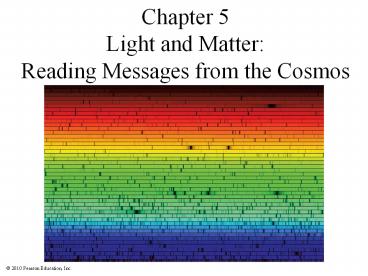
Title: Chapter 5 Light and Matter: Reading Messages from the Cosmos
1
Chapter 5Light and Matter Reading Messages
from the Cosmos
2
5.1 Light in Everyday Life
- Our goals for learning
- How do we experience light?
- How do light and matter interact?
3
How do we experience light?
- The warmth of sunlight tells us that light is a
form of energy. - We can measure the flow of energy in light in
units of watts 1 watt 1 joule/s.
4
Colors of Light
- White light is made up of many different colors.
5
How do light and matter interact?
- Emission
- Absorption
- Transmission
- Transparent objects transmit light.
- Opaque objects block (absorb) light.
- Reflection/scattering
6
Reflection and Scattering
Mirror reflects light in a particular direction.
Movie screen scatters light in all directions.
7
Interactions of Light with Matter
Interactions between light and matter determine
the appearance of everything around us.
8
Thought QuestionWhy is a rose red?
- The rose absorbs red light.
- The rose transmits red light.
- The rose emits red light.
- The rose reflects red light.
9
Thought QuestionWhy is a rose red?
- The rose absorbs red light.
- The rose transmits red light.
- The rose emits red light.
- The rose reflects red light.
10
What have we learned?
- How do we experience light?
- Light is a form of energy.
- Light comes in many colors that combine to form
white light. - How do light and matter interact?
- Matter can emit light, absorb light, transmit
light, and reflect (or scatter) light. - Interactions between light and matter determine
the appearance of everything we see.
11
5.2 Properties of Light
- Our goals for learning
- What is light?
- What is the electromagnetic spectrum?
12
What is light?
- Light can act either like a wave or like a
particle. - Particles of light are called photons.
13
Waves
- A wave is a pattern of motion that can carry
energy without carrying matter along with it.
14
Properties of Waves
- Wavelength is the distance between two wave
peaks. - Frequency is the number of times per second that
a wave vibrates up and down. - Wave speed wavelength ? frequency
15
Light Electromagnetic Waves
- A light wave is a vibration of electric and
magnetic fields. - Light interacts with charged particles through
these electric and magnetic fields.
16
Wavelength and Frequency
- wavelength ? frequency speed of light constant
17
Particles of Light
- Particles of light are called photons.
- Each photon has a wavelength and a frequency.
- The energy of a photon depends on its frequency.
18
Wavelength, Frequency, and Energy
- l ? f c
- l wavelength, f frequency
- c 3.00 ? 108 m/s speed of light
- E h ? f photon energy
- h 6.626 ? 10-34 joule ? s photon energy
19
Special Topic Polarized Sunglasses
- Polarization describes the direction in which a
light wave is vibrating. - Reflection can change the polarization of light.
- Polarized sunglasses block light that reflects
off of horizontal surfaces.
20
What is the electromagnetic spectrum?
21
The Electromagnetic Spectrum
22
Thought QuestionThe higher the photon energy,
- the longer its wavelength.
- the shorter its wavelength.
- energy is independent of wavelength.
23
Thought QuestionThe higher the photon energy,
- the longer its wavelength.
- the shorter its wavelength.
- energy is independent of wavelength.
24
What have we learned?
- What is light?
- Light can behave like either a wave or a
particle. - A light wave is a vibration of electric and
magnetic fields. - Light waves have a wavelength and a frequency.
- Photons are particles of light.
- What is the electromagnetic spectrum?
- Human eyes cannot see most forms of light.
- The entire range of wavelengths of light is known
as the electromagnetic spectrum.
25
5.3 Properties of Matter
- Our goals for learning
- What is the structure of matter?
- What are the phases of matter
- How is energy stored in atoms?
26
What is the structure of matter?
27
Atomic Terminology
- Atomic number of protons in nucleus
- Atomic mass number of protons neutrons
- Molecules consist of two or more atoms (H2O,
CO2)
28
Atomic Terminology
- Isotope same of protons but different of
neutrons (4He, 3He)
29
What are the phases of matter?
- Familiar phases
- Solid (ice)
- Liquid (water)
- Gas (water vapor)
- Phases of same material behave differently
because of differences in chemical bonds.
30
Phase Changes
- Ionization stripping of electrons, changing
atoms into plasma - Dissociation breaking of molecules into atoms
- Evaporation breaking of flexible chemical bonds,
changing liquid into solid - Melting breaking of rigid chemical bonds,
changing solid into liquid
31
Phases and Pressure
- Phase of a substance depends on both temperature
and pressure. - Often more than one phase is present.
32
How is energy stored in atoms?
Excited states
Ground state
- Electrons in atoms are restricted to particular
energy levels.
33
Energy Level Transitions
- The only allowed changes in energy are those
corresponding to a transition between energy
levels.
34
What have we learned?
- What is the structure of matter?
- Matter is made of atoms, which consist of a
nucleus of protons and neutrons surrounded by a
cloud of electrons. - What are the phases of matter?
- Adding heat to a substance changes its phase by
breaking chemical bonds. - As temperature rises, a substance transforms from
a solid to a liquid to a gas, then the molecules
can dissociate into atoms. - Stripping of electrons from atoms (ionization)
turns the substance into a plasma.
35
What have we learned?
- How is energy stored in atoms?
- The energies of electrons in atoms correspond to
particular energy levels. - Atoms gain and lose energy only in amounts
corresponding to particular changes in energy
levels.
36
5.4 Learning from Light
- Our goals for learning
- What are the three basic types of spectra?
- How does light tell us what things are made of?
- How does light tell us the temperatures of
planets and stars? - How do we interpret an actual spectrum?
37
What are the three basic types of spectra?
Spectra of astrophysical objects are usually
combinations of these three basic types.
38
(No Transcript)
39
Three Types of Spectra
40
Continuous Spectrum
- The spectrum of a common (incandescent) light
bulb spans all visible wavelengths, without
interruption.
41
Emission Line Spectrum
- A thin or low-density cloud of gas emits light
only at specific wavelengths that depend on its
composition and temperature, producing a spectrum
with bright emission lines.
42
Absorption Line Spectrum
- A cloud of gas between us and a light bulb can
absorb light of specific wavelengths, leaving
dark absorption lines in the spectrum.
43
How does light tell us what things are made of?
44
Chemical Fingerprints
- Each type of atom has a unique set of energy
levels. - Each transition corresponds to a unique photon
energy, frequency, and wavelength.
Energy levels of hydrogen
45
Chemical Fingerprints
- Downward transitions produce a unique pattern of
emission lines.
46
(No Transcript)
47
Chemical Fingerprints
- Because those atoms can absorb photons with those
same energies, upward transitions produce a
pattern of absorption lines at the same
wavelengths.
48
(No Transcript)
49
Chemical Fingerprints
- Each type of atom has a unique spectral
fingerprint.
50
Chemical Fingerprints
- Observing the fingerprints in a spectrum tells us
which kinds of atoms are present.
51
Example Solar Spectrum
52
Energy Levels of Molecules
- Molecules have additional energy levels because
they can vibrate and rotate.
53
Energy Levels of Molecules
- The large numbers of vibrational and rotational
energy levels can make the spectra of molecules
very complicated. - Many of these molecular transitions are in the
infrared part of the spectrum.
54
Thought Question Which letter(s) label(s)
absorption lines?
55
Thought Question Which letter(s) label(s)
absorption lines?
56
Thought Question Which letter(s) label(s) the
peak (greatest intensity) of infrared light?
57
Thought Question Which letter(s) label(s) the
peak (greatest intensity) of infrared light?
58
Thought Question Which letter(s) label(s)
emission lines?
59
Thought Question Which letter(s) label(s)
emission lines?
60
How does light tell us the temperatures of
planets and stars?
61
Thermal Radiation
- Nearly all large or dense objects emit thermal
radiation, including stars, planets, you. - An objects thermal radiation spectrum depends on
only one property its temperature.
62
Properties of Thermal Radiation
- Hotter objects emit more light at all frequencies
per unit area. - Hotter objects emit photons with a higher average
energy.
63
Wiens Law
64
Thought QuestionWhich is hottest?
- a blue star
- a red star
- a planet that emits only infrared light
65
Thought QuestionWhich is hottest?
- a blue star
- a red star
- a planet that emits only infrared light
66
Thought QuestionWhy dont we glow in the dark?
- People do not emit any kind of light.
- People only emit light that is invisible to our
eyes. - People are too small to emit enough light for us
to see. - People do not contain enough radioactive material.
67
Thought QuestionWhy dont we glow in the dark?
- People do not emit any kind of light.
- People only emit light that is invisible to our
eyes. - People are too small to emit enough light for us
to see. - People do not contain enough radioactive material.
68
How do we interpret an actual spectrum?
- By carefully studying the features in a spectrum,
we can learn a great deal about the object that
created it.
69
What is this object?
Reflected sunlight Continuous spectrum of
visible light is like the Suns except that some
of the blue light has been absorbedobject must
look red.
70
What is this object?
Thermal radiation Infrared spectrum peaks at a
wavelength corresponding to a temperature of 225
K.
71
What is this object?
Carbon dioxide Absorption lines are the
fingerprint of CO2 in the atmosphere.
72
What is this object?
Ultraviolet emission lines Indicate a hot upper
atmosphere
73
What is this object?
Mars!
74
What have we learned?
- What are the three basic type of spectra?
- Continuous spectrum, emission line spectrum,
absorption line spectrum - How does light tell us what things are made of?
- Each atom has a unique fingerprint.
- We can determine which atoms something is made of
by looking for their fingerprints in the spectrum.
75
What have we learned?
- How does light tell us the temperatures of
planets and stars? - Nearly all large or dense objects emit a
continuous spectrum that depends on temperature. - The spectrum of that thermal radiation tells us
the objects temperature. - How do we interpret an actual spectrum?
- By carefully studying the features in a spectrum,
we can learn a great deal about the object that
created it.
76
5.5 The Doppler Shift
- Our goals for learning
- How does light tell us the speed of a distant
object? - How does light tell us the rotation rate of an
object?
77
How does light tell us the speed of a distant
object?
78
The Doppler Effect
79
Same for Light
80
Measuring the Shift
Stationary
Moving away
Away faster
Moving toward
Toward faster
- We generally measure the Doppler effect from
shifts in the wavelengths of spectral lines.
81
The amount of blueshift or redshift tells us an
objects speed toward or away from us.
82
Doppler shift tells us ONLY about the part of an
objects motion toward or away from us
83
Thought Question
I measure a line in the lab at 500.7 nm. The same
line in a star has wavelength 502.8 nm. What can
I say about this star?
- It is moving away from me.
- It is moving toward me.
- It has unusually long spectral lines.
84
Thought Question
I measure a line in the lab at 500.7 nm. The same
line in a star has wavelength 502.8 nm. What can
I say about this star?
- It is moving away from me.
- It is moving toward me.
- It has unusually long spectral lines.
85
Measuring Redshift
86
Measuring Redshift
87
Measuring Velocity
88
Measuring Velocity
89
How does light tell us the rotation rate of an
object?
- Different Doppler shifts from different sides of
a rotating object spread out its spectral lines.
90
Spectrum of a Rotating Object
- Spectral lines are wider when an object rotates
faster.
91
What have we learned?
- How does light tell us the speed of a distant
object? - The Doppler effect tells us how fast an object is
moving toward or away from us. - Blueshift objects moving toward us
- Redshift objects moving away from us
- How does light tell us the rotation rate of an
object? - The width of an objects spectral lines can tell
us how fast it is rotating.
Recommended

