

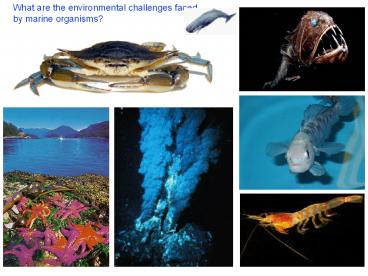
What are the environmental challenges faced by marine organisms? PowerPoint PPT Presentation
1 / 31
Title: What are the environmental challenges faced by marine organisms?
1
What are the environmental challenges faced by
marine organisms?
2
Temperature Body T terms
- Ectotherms body temperature varies in concert
with the temperature of the surrounding
environment. - Endotherms regulate the amount of heat produced
catabolically, either regionally or globally. - Homeotherms maintain a stable body T through
behavior, insulation, coloration, circulatory
regulation, and the regulation of cellular heat
production. e.g., homeothermic endotherm
regulate metabolism to maintain constant body T. - Heterotherms can temporally or regionally
regulate endothermic heat production. e.g.,
regional heterothermic endotherm use metabolic
processes to heat a region of the body. e.g.,
temporal heterothermic endotherm body
temperature varies over time. - 2 Strategies for endothermy, based on the fact
that no process is 100 efficient (e.g., 38 of
energy from glucose oxidation is stored as ATP)
- Increase the rate of metabolic flux.
- Decrease the efficiency of metabolic flux.
3
Brown Adipose Tissue in Mammals
Temperature Heat production/conservation
Oxygen consumption is normally tightly coupled
to ATP production. Uncoupling proteins (UCP)
uncouples this process to generate heat
4
(No Transcript)
5
- Internalized red muscle of tuna (top left), and
the heat exchanger (top right) and heater organ
cell of the blue marlin (bottom). - Skipjack tuna has heat exchanger below vertebral
column.
Block et al. 1991
6
Proposed mechanism of excitation-thermogenic
coupling in cranial heater organs of fishes.
Ca2 futile cycling, ATP hydrolysis and the
electron transport system all produce heat. From
Block, 1991.
7
Temperature Protection against freezing
- Why is freezing bad for organisms?
- Colligative properties fishes elevate glycerol
and TMAO concentrations in the cold (including
seasonal variations). - This depresses the freezing point.
- Non-colligative properties Antifreeze proteins
(AFP) and antifreeze glycoproteins (AFGP). First
found in antarctic Nototheniid fishes by DeVries
(1971). Since found in many taxa including
plants, fungi and bacteria. - AFPs and AFGPs depress the freezing point below
the thermodynamic melting point. Often called
thermal hysteresis proteins (THPs).
8
- Convergent evolution of AFPs and AFGPs in fishes.
4 AFPs and 1 AFGP that are known do not follow
evolutionary lineages in fish. - Other properties of THPs
- THPs integrate in the ice.
- THPs make ice crystals grow quickly and in a
needle-like conformation. - THPs limit ice recrystallization.
- They accomplish these goals by binding to ice
crystals.
Fletcher et al. 2001
9
Mechanism of THP action. Normal ice crystal
growth occurs with a low radius of curvature (top
left). When THPs bind the ice, the available
surfaces for crystal growth have a high radius of
curvature (top right). In insects, an
ice-nucleating protein (PIN) aggregates several
THPs to enhance the antifreeze function
(Hochachka and Somero, 2002).
10
Temperature Effects on Membranes
11
Major membrane components
Phosphotidylcholine (PC)
Phosphotidylethanolamine (PE)
PC
PE
12
Membranes are stabilized by the hydrophobic
interaction and van der Waals forces.
13
Membrane phase and static order
(fluidity/viscosity) must be conserved across
temperatures
Homeophasic acclimation/adaptation Conservation
of phase at different temperatures.
Phosphatidylcholine (PC) is cylindrical, while
phosphatidylethanolamine (PE) is conical (more
unsaturated). The PCPE ratio is higher in more
warm adapted species.
14
Increased cholesterol also helps stabilize
membranes important in warm adaptation/acclimati
on
15
- Homeoviscous adaptation in brain synaptic
membranes maintenance of membrane fluidity at
different temperatures. - DPH is a probe that intercalates in membranes.
- High DPH anisotropy indicates low fluidity.
- Note effect of temperature (top) and homeoviscous
adaptation at the adaptation temperature (below).
This mode of adapation is complete within the
horizontal lines.
(Logue et al. 2000)
16
Temperature Effects on Proteins
- Temperature effects on metabolism encapsulated by
Q10. - Q10 (k1/k2)10/(t1-t2)
- For many processes (e.g., rates of respiration,
enzyme activities), Q10 ? 2, when the temperature
effects are measured within an organisms
physiological range.
17
- Temperature is a measure of the level of kinetic
energy most frequently occupied by molecules in
the system. Higher kinetic energies lead to
higher chemical reactivities. - However, if body T is 298 K, a 10 change is only
a 10/298 (3) change in the average kinetic
energy of the system. So how is Q10 ? 2? - Arrhenius - examine not only most common energy
state (temperature), but also the high energy
states that exceed the activation energy.
18
Adaptations/Acclimations to temperature include
modifications of protein quality and quantity
- Organisms in the cold must speed up metabolism
to compensate for slowing effects of cold. - Often found that at a common temperature,
cold-adapted or cold acclimated species have
higher biological rates. - How might this be accomplished?
- Enzyme activity units of Units! (?moles/min)
19
Temperature compensation of metabolism may
involve changes in enzyme quantity (here is an
example in a cold-acclimated species)
Striped bass Morone saxatilis red muscle cell
acclimated to 25 C (left) and to 5 C (right).
From Egginton and Sidell (1989). Note increase
in mitochondria and lipid droplets in cold
acclimated cell. Thus, cold acclimation usually
involves increases in the number of enzymes, not
in their quality.
20
Temperature compensation may involve changes in
protein quality (here is an example for
temperature adaptation)
Fields and Somero, 1998
A4-LDH catalytic rates for differently thermally
adapted vertebrates. At a common temperature,
cold adapted enzymes perform better than warm
adapted enzymes. kcat rate of catalysis/active
site Vmax/E. Why isnt a very fast catalytic
rate selected for in warm adapted enzymes?
21
Temperature compensation may involve changes in
protein quality and quantity (here is an example
for temperature adaptation)
Temperature compensation of LDH and CS activity
(kcat x enzyme) in brain of Antarctic and
tropical adapted fish. Measurements were made at
10 C and extrapolated to the habitat temperature
(0 or 25 C). Numbers on plot represent the
activity at habitat temperature. Although
temperature compensation occurs (higher
activities at a common temperature in the cold
adapted species), there is still a 2-fold
difference in activity at the habitat
temperatures temperature compensation is
incomplete. Importantly, the higher activities
at a common temperature are proportional to the
change in kcat in the cold adapted species.
Thus, cold adapted enzymes are better, not more
abundant. (Kawall et al. 2001).
22
How do enzymes adjust kcat values during cold
adaptation?
- You can only increase a process rate by
increasing the rates of the slow steps in that
process.
Lactate dehydrogenase (LDH) Model for
temperature adaptation
23
Conformational changes in LDH during catalysis
and the LDH active site. Note that the ?-helix
doors above clamp shut when substrates are in
the active site. Also note essential His-193 and
Arg-171.
24
3D structure of LDH. The catalytic loop is
highly conserved, and along with the ?H helix and
the ?1G-2G, form highly mobile doors that swing
open to allow substrates to get to the active
site and close to lock substrates in the
appropriate position for catalysis.
25
Why isnt kcat maximized for all enzymes?
- There is a trade-off between kcat and binding
affinity (Km). - Enzymes breath, and a population of enzymes
occupies an ensemble of conformations, only some
of which can bind substrates.
26
- Binding affinity is described by the Km.
Low Km high substrate affinity, High Km low
substrate affinity.
27
(No Transcript)
28
- In summary, enzymes must
- Be structurally stable enough to competently bind
substrates, but flexible enough to facilitate
conformational change. - Be able to rapidly catalyze reactions.
- Be able to recognize and bind substrates at
physiological concentrations. - These enzyme properties co-evolve!!
29
- Global protein stability is often independent of
kinetic properties. - Proteins are only marginally stable.
- Protein stability also adapts to different
thermal regimes.
- How do proteins become more thermally stable?
- Increased charged amino acids.
- Increased bulky, hydrophobic residues.
- Also, thermoprotectant molecules and
macromolecular crowding may enhance stability.
30
- Fixing temperature-induced damage Proteins that
are denatured must be refolded properly. - Heat-shock proteins (HSP) play a role in
refolding.
31
Cool Cool Warm Very warm
(Tomanek and Somero, 1999)
Recommended

