

Nature vs. Nurture PowerPoint PPT Presentation
1 / 70
Title: Nature vs. Nurture
1
Nature vs. Nurture
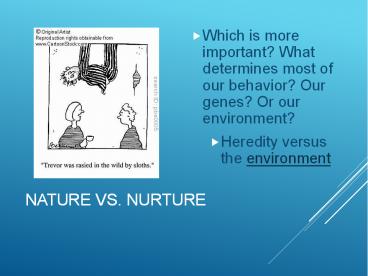
- Which is more important? What determines most of
our behavior? Our genes? Or our environment? - Heredity versus the environment
2
- Universal people communicate both verbally and
nonverbally - enforce rules of etiquette
- They avoid incest, fear snakes, and exchange
gifts. - Universal people demonstrate modesty in sexual
behavior and bodily functions, even if they dont
wear clothes. - Everywhere labor is divided by age and by gender.
Men are more aggressive than women women provide
more child care. - Every culture has tools
- Everywhere, people form beliefs about death and
disease, they plan for the future. - All cultures have taboos, including tabooed
utterances. Sanctions exist for crimes against
society, and mechanisms for dealing with theft,
murder, and rape are universal. - People everywhere recognize marriage
- They mimic, flirt, envy, empathize, joke, tease,
- They dance and make music
3
Genes Our Codes for Life
- Chromosome
- DNA (deoxyribonucleic acid)
- Genes
4
Blue Eyes?
5
Twin and Adoption StudiesIdentical Versus
Fraternal Twins
- Identical twins
- Fraternal twins
6
Twin and Adoption StudiesIdentical Versus
Fraternal Twins
7
Twin and Adoption StudiesIdentical Versus
Fraternal Twins
8
Twin and Adoption StudiesIdentical Versus
Fraternal Twins
9
Twin and Adoption StudiesIdentical Versus
Fraternal Twins
10
Twin and Adoption StudiesIdentical Versus
Fraternal Twins
11
Twin and Adoption StudiesIdentical Versus
Fraternal Twins
12
Twin and Adoption StudiesSeparated Twins
- U of MN studies on identical twins separated at
birth- two Jims (hobbies, habits, dogs name,
sons name)
13
- Gerald Levey and Mark Newman, both
- Work as volunteer firefighters
- Like the same beer (Budweiser)
- Are attracted to the same kinds of women
- Gerald worked in forestry, Mark worked for the
city trimming trees (planned to go to school for
forestry) - Both liked to hunt, fish, watch John Wayne movies
and eat Chinese food - Both grew the same sideburns and mustaches
- Used the same speaking inflections and hand
gestures
14
- Can you find a twin in this class?
15
- Anecdotal evidence
- Virtual twins
16
Twin and Adoption StudiesBiological Versus
Adoptive Relatives
- Genetic relatives
- Environmental relatives
- Are adopted children more like their biological
parents or adoptive parents?
17
- Well, it depends. Their personality traits (how
outgoing they are, how friendly, their overall
temperament) were much more similar to their
biological parents. - Environmental factors have almost no impact on
your personality - Children in the same family are often very
different - Do parents even matter?
18
- Parents influence
- Attitudes (such as toward education)
- Values
- Manners
- Faith
- Politics
- Less credit, less blame
19
Heritability
- Heritability
- difference among people
- How much of the variation among people can be
attributed to genes
20
Heritability of various traits
- IQ .22 at age 5, .54 - . 62 at old age
- Interests (art, science etc.) .36
- Psychiatric illnesses Schizophrenia (.80),
alcoholism (.50 to .60) - Religiousness .11 to .22
21
HeritabilityGroup Differences
- Heritable differences between individuals does
not imply heritable group differences
22
HeritabilityNature and Nurture
- Influence of adaptation
- Nature and nurture work together
- Genes are
self-regulating - They react to the
- environment
23
Gene-Environment Interaction
- Genes and experience interact
- Evocative interactions
- Mom likes you better! ?
24
Natural Selection and Adaptation
- Evolutionary psychology
- Natural selection
- Mutation
- Adaptation
- Fitness
25
Evolutionary Success Helps Explain Similarities
- Behaviors that contribute to survival are found
throughout cultures
26
- Why are children often afraid of the dark?
27
Evolutionary Success Helps Explain
SimilaritiesOutdated Tendencies
- Genetic traits which helped our ancestors survive
may harm us today
28
Experience and Faculties
- Repeated experiences modify neural tissue. We can
change our brains! When is the brains plasticity
highest? - Pruning
Courtesy of C. Brune
29
Brain Development and Adulthood
Brain development does not stop when we reach
adulthood. Throughout our life, brain tissue
continues to grow and change.
A well-learned finger-tapping task leads to more
motor cortical neurons (right) than baseline.
30
Peer Influence
In many ways, peers play a larger role than
parents in shaping our behavior. What causes
people to start smoking? Like a certain type of
music? Wear certain clothes? Talk the way they
talk? Evolutionary perspective on peers?
Ole Graf/ zefa/ Corbis
31
An Evolutionary Explanation of Human
SexualityNatural Selection and Mating Preferences
- Differing preferences in partners
- Male preferences
- Female preferences
32
- Men tend to look for
- Physical attractiveness and a youthful appearance
33
(No Transcript)
34
- A mans ideal women would look like
35
(No Transcript)
36
- Women tend to look for
- Maturity, dominance, status/affluence, and
boldness
37
(No Transcript)
38
- So a womans ideal man would look like
39
(No Transcript)
40
(No Transcript)
41
Characteristics Characteristics Preferred by
Males Preferred by Females 1. Kindness and 1.
Kindness and understanding understanding 2.
Intelligence 2. Intelligence 3. Physical
attractiveness 3. Exciting personality 4.
Exciting personality 4. Good health 5. Good
health 5. Adaptability 6. Adaptability 6.
Physical attractiveness 7. Creativity 7.
Creativity 8. Desire for children 8. Good
earning capacity 9. College graduate 9. College
graduate 10. Good heredity 10. Desire for
children 11. Good earning capacity 11. Good
heredity 12. Good housekeeper 12. Good
housekeeper 13. Religious orientation 13.
Religious orientation
42
Critiquing the Evolutionary Perspective
- Backward theorizing
- Impact of social influence
43
Cultural Influences
Humans have the ability to evolve culture.
Culture is composed of behaviors, ideas,
attitudes, values and traditions shared by a
group.
44
Variation Across Culture
Cultures differ. Each culture develops norms
rules for accepted and expected behavior. Men
holding hands in Saudi Arabia is the norm (closer
personal space), but not in American culture.
Jason Reed/ Reuters/Corbis
45
(No Transcript)
46
(No Transcript)
47
Variation Over Time
Cultures change over time. The rate of this
change may be extremely fast. In many Western
countries, culture has rapidly changed over the
past 40 years or so.
This change cannot be attributed to changes in
the human gene pool because genes evolve very
slowly.
48
Culture and the Self
If a culture nurtures an individuals personal
identity, it is said to be individualist, but if
a group identity is favored then the culture is
described as collectivist. A collectivist
support system can benefit groups who experience
disasters such as the 2005 earthquake in Pakistan.
Kyodo News
49
Gender Differences in Aggression
Men express themselves and behave in more
aggressive ways than do women. This aggression
gender gap appears in many cultures and at
various ages.
In males, the nature of this aggression is
physical. In the U.S. the male to female arrest
rate is 9 to 1. Men are more likely to support
war as a solution to international problems
50
- Why men dont ask for directions vid.
51
Gender and Social Power
In most societies, men are socially dominant and
are perceived as such.
In 2005, men accounted for 84 of the governing
parliaments.
52
Gender Differences and Connectedness
Young and old, women form more connections
(friendships) with people than do men.
Men emphasize freedom and self-reliance. -
Playgrounds - How men stand
Oliver Eltinger/ Zefa/ Corbis
Dex Image/ Getty Images
53
- A study of 30 countries, including the regions of
Western Europe, Asia, South America, and Africa,
found traits correlated with men to be active,
adventurous, aggressive, arrogant, autocratic,
bossy, coarse, conceited, enterprising,
hardheaded, loud, obnoxious, opinionated,
opportunistic, pleasure-seeking, precise, quick,
reckless, show-off, and tough - Traits correlated with women included affected,
affectionate, appreciative, cautious, changeable,
charming, dependent, emotional, fearful,
forgiving, modest, nervous, patient, pleasant,
prudish, sensitive, sentimental, softhearted,
timid, and warm
54
The New Frontier Molecular Genetics
- Molecular genetics
- Molecular behavior genetics
- Genetics and diseases
- Genetics and ethics
55
The End
56
Definition Slides
57
Behavior genetics
- the study of the relative power and limits of
genetic and environmental influences on behavior.
58
Environment
- every non-genetic influence, from prenatal
nutrition to the people and things around us.
59
Chromosomes
- threadlike structures made of DNA molecules
that contain the genes.
60
DNA (deoxyribonucleic acid)
- a complex molecule containing the genetic
information that makes up the chromosomes.
61
Genes
- the biochemical units of heredity that make up
the chromosomes segments of DNA capable of
synthesizing a protein.
62
Genome
- the complete instructions for making an
organism, consisting of all the genetic material
in that organisms chromosomes.
63
Identical Twins
- twins who develop from a single fertilized egg
that splits in two, creating two genetically
identical organisms.
64
Fraternal Twins
- twins who develop from separate fertilized
eggs. They are genetically no closer than
brothers and sisters, but they share a fetal
environment.
65
Heritability
- the proportion of variation among individuals
that we can attribute to genes. The heritability
of a trait may vary, depending on the range of
populations and environments studied.
66
Interaction
- the interplay that occurs when the effect of
one factor (such as environment) depends on
another factor (such as heredity).
67
Molecular Genetics
- the subfield of biology that studies the
molecular structure and function of genes.
68
Evolutionary Psychology
- the study of the evolution of behavior and the
mind,using principles of natural selection.
69
Natural Selection
- the principle that, among the range of
inherited trait variations, those that lead to
increased reproduction and survival will most
likely be passed on to succeeding generations.
70
Mutation
- the random error in gene replication that leads
to a change.
Recommended

