

Liquid Argon TPC High Voltage Issues PowerPoint PPT Presentation
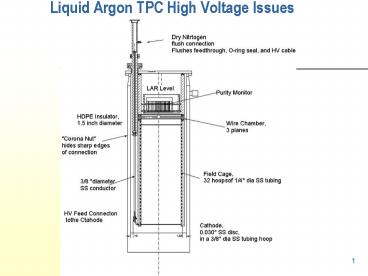
1 / 27
Title: Liquid Argon TPC High Voltage Issues
1
Liquid Argon TPC High Voltage Issues
2
Voltage and current needs
- Drift
- velocity
- sets
- the scale
3
Choice of Electric field Strength
- Choice of Electric field Strength
- Based on
- Reasonable drift time
- Example A field of 500 V/cm drifts electrons
at 1.5 mm/microsec. It requires an electron
lifetime of about 2 msec. This seems achievable
- For a 3 m drift distance, the dwell time is 2
msec. - High Voltage Technology gets hard quickly at very
large voltages.
4
Choice of Drift Field -- 2
- Technical limitations
- Our example requires HV (500 v/cm) (300 cm)
150 kV - If we were to try and double this, the total
voltage would be 300 kV, which is quite
challenging, while the dwell time would only go
down to 1.5 msec. - In the other direction, if we were to halve the
E-field to 250 V/cm, the dwell time would grow
to 3 msec, not a big change from 2 msec, - but a huge voltage reduction, from 150kV to 75
kV, going from achievable to routine.
5
Voltage Regulation Requirements
- We pick an acceptable drift distance measurement
tolerance of, say, 0.5 mm. For our example of
3m drift distance, this is 1/6000. - The drift velocity must be constant at this
level. - The velocity versus field curve is not linear.
- We find that at 250 V/cm we must regulate the
Voltage to 1/4300 - For 500 V/cm we need to regulate to 1/2800
- And for 1000 V/cm we need to regulate to 1/2400
- Not a big effect !
6
Current Flow Issues
- Filter and Leakage Currents
- Leakage currents are not well predicted, usually.
- If we assume a leakage current of 100 microamp,
as an example, then for the 500 V/cm case we are
allowed a voltage variation of (150 kV) / 2800
54 Volts - Any series resistor in the HV filter must then be
540 kilo-ohms or lower. - Electron drift current
- The Physics current, due to ionization in tracks
is small - We assume about 55,000 electrons per cm of track.
If we take an example of 3 events per msec,
each with a track length of 10 m, we get an
ionization current of 1.6 E11 electrons/sec,
which is 26 micro-amps.
7
Noise Requirements
- Noise Requirements
- Noise on the HV supplies (Main drift HV and
ancillary wire chamber bias supplies) couples
capacitively into the wire chambers. - Main Drift HV Supply
- The noise of the main HV supply affects only the
first induction plane. - The induced noise can be estimated from the
noise fraction on the main drift field, induced
into one wire. - For our prototype we estimate the capacitance
from the Main HV into one wire as about 1 pF. A
1 Volt pulse on the HV will induce a charge of
1E-12 C, which corresponds to 6250 electrons. - The induced charge from a real track ionization
is about (55,000 e) (1 cm / wire spacing)
27,500 electrons.
8
Signal to Noise
- For a signal to HV noise ratio of 1, we need to
hold the HV ripple to 10 mV in the frequency
region of interest. - Note that modern high frequency supplies often
run in then 100 kHz range which is just about
where we care the most. - A Filter is needed.
9
HV Filter Parameters
- If we assume a supply with 10 Volt ripple, we
need to reduce the ripple by a factor of 1000x.
- Using an RC filter, we are further constrained by
the maximum series resistor , due to leakage
currents, of 540 kOhms (see above). - An RC filter is a voltage divider.
- The noise is divided (approx) in the ratio
(Series resistor / Capacitor impedance). - The capacitor impedance must be 1000 x smaller
than the 450 kOhm series resistor, i.e. 450 Ohms.
The capacitors impedance at the frequency of
interest (100 kHz in our example) is R
C/(2Pifrequency). - W arrive at the required filter capacitance as C
1/ (450 Ohm 2pi100 kHz) 3.5 nF
10
Multi-Stage Filter
- This is rather large and dangerous.
- If we design the filter as a 3-stage RC filter,
we end up with each stage having an 18 kOhm
resistor and a 90 pF capacitor, which is much
easier and safer. - The next slide shows is the filter box for the
Flare prototype. - It is rather over-designed, but we had all the
components lying around, so it was free. We also
want to be able to deal with unknown noise
sources such as lower frequency noise.
11
Flare Prototype Filter Box
12
13
Wire Chamber Bias Supplies
- The field strength must increase after each wire
plane by about 50 to collect all drift electrons
without allowing them to reach the wires. - For a plane spacing of about a cm, these supplies
are in the 0.5 to 2 kV range. - Common supplies designed for phototubes are quite
suitable. - They are well regulated and come with voltage and
current readback. - Even though the noise coupling capacitances are
somewhat larger here, no problems are expected.
- Feedthroughs are not extreme, but require care.
14
HV Feedthrough Issues
- The main drift HV feedthrough into the cold
volume poses some interesting challenges - --high voltages
- --low breakdown voltage in Argon gas
- --cold end
- --gas seal
- --prevent oxygen diffusion into the liquid argon
- --Materials compatibility with argon purity
15
High Voltage Capability
- For the range up to 200 kV there is substantial
experience , e.g. from particle separators. - Standard coaxial cables exist.
- At the outer cable end, the outer jacket and wire
shield is usually pulled back, while the
polyethylene inner insulator continues for
several inches. - The assembly dips into a dielectric cavity, and
makes contact with some spring arrangement. The
wire shield is tied to the outer shield of the
feed through assembly. - At the Argon side, care must be taken not to
expose any conductor to the gaseous Argon, which
has a low electric field holding capability. - The liquid Argon, by contrast , can hold of as
much as 2 mega-volts per cm.
16
HV Feedthrough Design
- Following Icarus practice, we make the
feedthrough dielectric from a single HDPE rod
that is long enough to dip well into the liquid
Argon. - The gas seal consists, as it must, of an inner
conductor seal and an outer dielectric seal. - Both seals rely on O-rings.
- The inner conductor seal is located at the bottom
of the outer cavity, where it stays warm, and is
spring loaded against the dielectric with a set
of Bellville washers that reside on the cold end,
inside of a corona ball. - The outer dielectric seal is warm also, and is
incorporated into a pair of modified CF flanges. - Both O-rings are continuously flushed with dry
nitrogen (or dry Argonyet to be decided) to
prevent oxygen diffusion into the TPC argon..
Oxygen diffusion through Viton (fluorocarbon)
and most other suitable materials is significant.
17
Flare HVFeed-through
18
Micro-Discharges
- The Icarus experiment had problems with HV micro
discharges inside cables and at connections.
These discharges appear to be enabled by
humidity. - Common cures include bathing the contacts in
Fluorinert liquid and flushing with dry nitrogen. - We have adopted the latter.
- A fitting on the main feedthrough will be
supplied with dry nitrogen gas continuously. - A small passage hole channels some of the gas
into the space surrounding outer O-ring, and the
rest flushes the plug connection and flows into
the outer jacket space of the HV cable. - A similar flush line will protect the HV filter
and its supply and return cables.
19
HV Monitoring
- DC monitoring
- For value and stability of the DC voltages
- This is done by taking a small fraction of the
voltage at the bottom of divider chains. - It is particularly important to monitor the
Voltage inside the TPC because it may have been
reduced by unexpected leakage currents. One can
imagine taking the test output from the cage
divider and using it to regulate the DC supply. - AC Monitoring
- Ac voltages are monitored from the last divider
resistor. - AC problems may include noise drift and micro
discharges. Use an oscilloscope or a discharge
detector, a la Icarus.
20
Current Monitoring
- Leakage currents can be a problem and an early
indictor of developing HV problems. - Currents are difficult to monitor in HV systems.
- The HV supply has often a ground-referenced
current output for that purpose.
21
Electrical HV Safety
- These protective measures need to be taken
- --- All devices are connected together with a
good grounding cable, e.g. of size 1/2inch x 1/8
inch woven copper - --- all HV devices have internal self-discharge
resistors with a limited discharge time, e.g. one
minute time constant or less - ---all HV devices have a voltage divider output
for monitoring their discharge status - --all HV devices are fed through a high value,
low power, resistor which limits any spark
currents and functions a s a fuse in abnormal
current conditions. The fuse for the TPC should
be located outside the TPC, e.g. inside the
filter box, for easy access.
22
Field Cage Design
- The drift field needs to be uniform to preserve
the reconstructed event topology accurately. - Typically the field needs to be shaped by a field
cage, consisting of equipotential Loops. - Icarus has built those from Stainless steel
tubing, held with PEEK insulators to the vessel
structure. Chains of resistors divide the Main
drift HV into appropriate steps. - They have also use sheets of printed circuit on
fiberglass-epoxy for a smaller test chamber.
For large detectors, stainless tubing seems to
offer advantages.
23
Electric Field Uniformity
24
Electric Field Uniformity--2
- Electrons drift along filed lines, at right angle
to equipotential surfaces. - It is convenient to have electrons drift exactly
along straight paths. - Very close to the cage hoops there will be
distortions. - Yet the electrons drift path is still
deterministic, and can be calculated from the
field map via the hoop geometry. If we know how
far each electron has drifted, we can
accurately determine its place of origin.
25
Electric Field Uniformity--3
- However, if we do not know the event time, we
cannot do this and must reject the data very
close to the hoops, except to gain topology
information. - This is important information, e.g. when vetoing
tracks entering from the outside. - In this case there is essentially no loss of
fiducial volume. - We can use a very coarse cage structure, which is
easier to build.
26
Resistors must meet several requirements
- --be compatible with cooling
- --do not change resistance uncontrollably when
cold - --do not suffer damage from thermal cycles
- --be able to hold off the step voltage without
internal discharges - --be very reliable
- --be free of electronegative materials or
contaminants
27
Resistors can be attached in different ways
- --solder to lugs on the SS tubing
- --plug into holes using proper electrical
contacts - For redundancy on their larger detectors, Icarus
has used four parallel resistor chains.
Recommended

