

Chapter 6 Histology PowerPoint PPT Presentation
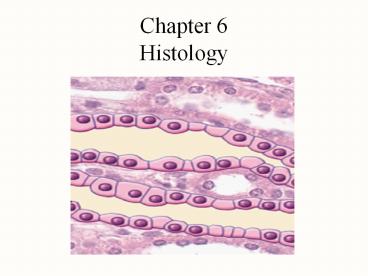
Title: Chapter 6 Histology
1
Chapter 6Histology
2
What is Histology
- Histology is the study of tissues and how they
are arranged into organs. - histo- tissue ology- study of
- Objectives Name, draw, recognize and
differentiate the function of the four primary
classes and their subcategories which adult
tissues are classified.
3
Chapter 6 Histology
- Introduction -tissues
- a) multicullar structure tissues contain cells
of similar type. The cells work together to
perform a specific function. - b)cells and matrix
- 1) matrix- extracellular material containing
protein and mineral salts. - 2) fluid surrounding cells is the interstitial
fluid (Inter - between cells vs. Intra inside a
cell)
4
Chapter 6 Histology
- 2) Embryonic tissues- tissues from which all
other tissues will arise. Starts with fertilized
egg. Forms 3 layers (strata) called the primary
germ layers. - a) ectoderm (outer) -forms epidermis nervous
system - b) endoderm (inner)-forms mucous membrane lining
GI tract respiratory system and digestive
glands - c) mesoderm (middle)-forms mesenchyme that gives
rise to muscle, bone, blood and other connective
tissues
5
Chapter 6 Histology
- 3) 4 basic tissue types (adult)
- a) epithelial
- 1) one or more cell layers thick, free surface
- 2) simple or stratified
- 3) coverings protection, secretion absorption
6
Chapter 6 Histology
- 3) 4 basic tissue types (adult)
- b) connective
- 1) extensive extracellular matrix collagen
(flexible but strong), elastin (elastic
qualities) - 2) support, binding, protective
- 3) Connective tissue proper- Loose (adipose
(fat)) tissue, Areolar (loosely binds epithelial
cells to deeper tissue, and Reticular
(supportive framework for lymphatic organs.
7
Epithelial Tissue
- There are two major categories of epithelial
tissue membranous and glandular. - Membranous The outer layer of skin, inner
lining of cavities and lumina and coverings of
visceral (internal-especially the heart, lungs,
liver, pancreas or intestines) organs. - Glandular specialized tissue that form
secretory portions of glands.
8
Membranous- Simple Epithelia
- Simple Epithelial Tissue single layer thick and
is located where diffusion, absorption,
filtration and secretion are principle functions.
- Some cells contain cilia that move materials
across cell surfaces. - Other cells contain microvilli that increase
surface area for absorption.
9
Membranous- Simple Epithelia
- Simple Squamous Epithelium Flattened ,
irregularly shaped cells with an oval centrally
located nucleus. Write down three places in the
body where each type of epithelial cell can be
found.
10
Membranous- Simple Epithelia
- Simple Columnar Epithelium Tall, columnar cells
with a single nucleus located near the basement
membrane. Specialized unicellular glands called
Goblet cells are scattered through this tissue.
Goblet cells secrete a lubricative and protective
mucus. Write locations.
11
Membranous- Simple Epithelia
- Simple Cuboidal Epithelium Tightly fitted cube
shaped cells found lining the lumina of small
ducts and tubules that have excretory, secretory
and absorptive functions. - Write locations.
12
Membranous- Simple Epithelia
- Simple Ciliated Columnar Epithelium Similar to
columnar cells but with cilia along the free
surface. Cilia do what? Where are they located?
13
Membranous- Simple Epithelia
- Pseudostratified Ciliated Columnar Epithelium
Ciliated columnar epithelium that appears to be
layered- but each cell is anchored to the
basement membrane. Write location.
14
Membranous- Stratified Epithelia
- Stratified Epithelia Tissue consisting of two
or more layers. This tissue is primarily
protective and enhanced by rapid cell divisions.
Stratified epithelia are classified according to
the shape of the surface layer of cells. - Why is this tissue not well suited for
absorption and secretion?
15
Membranous- Stratified Epithelia
- Stratified Squamous Epithelium Composed of a
variable number of cell layers that are flattest
at the surface. Mitosis occurs at only at the
deepest layers. - Keratinized Contains keratin (strengthening
protein) - Nonkeratinized No keratin, called mucosa
- Where are they located?
16
Membranous- Stratified Epithelia
- Stratified Cuboidal Epithelium Consists of two
or three layers of cuboidal cells where
stratification provides a more robust lining.
What location?
17
Membranous- Stratified Epithelia
- Transitional Epithelium similar to
nonkeratinized stratified squamous epithelium.
Where is this located and what is the specific
function?
18
Chapter 6 Histology
- Body Membranes Thin layers of epithelial tissue
that cover, support and protect visceral organs
and line body cavities. - Mucous Membrane secrete thick mucus to
lubricate and protect associated organs. Oral and
nasal cavities, respiratory, reproductive,
urinary and digestive system. - Serous Membrane secrete serous fluid to help
protect. Pleurae (lungs), Pericardial (heart),
Peritoneal (adominopelvic)
19
Glandular Epithelia
- Glandular Epithelia Tiny invaginations
(infoldings) of membranous epithelia that give
rise to specialized secretory structures called
exocrine glands. - Unicellular Single cells (Example ?)
- Multicellular These can be simple or compound
and are composed of both secretory cells and
cells that form the walls of ducts.
20
Membranous- Stratified Epithelia
- Multicellular Exocrine Glands Are organized the
way they release their product. - Merocrine- exocytosis through cell membrane
- Apocrine- secretion accumulates near surface of
the cell and then is released with a portion of
the cell. - Holocrine- the entire secretory cell is
discharged along with secretory product.
21
Multicellular exocrine glands
22
Chapter 6 Histology
- 3) Connective cont. Dense regular (tendons and
ligaments), Dense irregular (dermis- forms
protective coverings around organs, bones, nerves
and most cartilages), Elastic (large arteries,
lower respiratory tract, between arches of
vertebrae)
23
Chapter 6 Histology
- Connective continued
- Cartilage- consisting of chondrocytes, provides
support along with elastic/flexible properties. - Bone- comprised of spongy bone and compact or
dense bone - Blood- fluid connective tissue
24
Cartilage
- Hyaline cartilage eases joint movement, holds
airway open during respiration, growth zones of
long bones in children.
25
Cartilage
- Elastic cartilage Abundant elastic fibers that
provide flexibility. Found in framework of outer
ear, auditory canal and portions of larynx.
26
Cartilage
- Fibrocartilage Abundant collagenous fibers that
withstand compression. Found in the symphysis
pubis, intervertebral discs, and knee joint.
27
Bone
- Bone The most rigid connective tissue. Unlike
cartilage, bone has a rich vascular supply and is
the site of metabolic activity. Bones density is
due mostly to inorganic calcium phosphate
(calcium hydroxyapatite). - Spongy (porous) (think Spongebob) or Compact
(dense)
28
Blood
- Blood vascular tissue or fluid connective tissue
that helps to maintain homeostasis. Contains
plasma, erythrocytes (red blood cells),
leukocytes (white blood cells), and thrombocytes
(platelets).
29
Question Review
- Why do some injuries to tendons and ligaments
require more time to heal than a broken bone.
Use your book and notes to formulate a reasonable
answer- you may use smart phones at this time.
(10 minutes)
30
Chapter 6 Histology
- 3) 4 basic tissue types (adult)
- c) muscle
- 1) skeletal, cardiac, smooth
- 2) contractile
- 3)excitable membrane potential
electrical charge
31
Skeletal Muscle
- Skeletal muscle attaches to bone and allows
voluntary movement. Muscle cells are
multinucleated, striated, cylindrical fibers.
32
Cardiac Muscle
- Cardiac muscle branched, striated fiber with a
single nucleus and intercalated discs (gap
junctions).
33
Smooth Muscle
- Smooth muscle Elongated, spindle fibers with a
single nucleus. Involuntary movement of internal
organs.
34
Review Question
- Why are skeletal muscle cells multinucleated and
why does cardiac muscle have intercalated disks?
Use your book and notes to formulate a reasonable
answer- you may use smart phones at this time.
(10 minutes)
35
Chapter 6 Histology
- 3) 4 basic tissue types (adult)
- d) nervous
- 1) Consits of neurons and neuroglia (or glial
cells) - 2) glia provide protection for neurons
- neurons nerve cells
- 3) Rapid signaling
- 4) Highly excitable membrane potential
36
Chapter 6 Histology
- Tissue growth and repair
- a) embryonic tissue differentiates into adult
tissue types. - b) growth
- 1) hyperplasia incr. cell .
- 2) hypertrophy - incr. cell size.
- c) shrinkage /death
- 1) atrophy- decr. in cell size
- 2) necrosis premature tissue death
- 3) infarction sudden death to interrupted
blood supply. - a) cell rupture, stimulated inflammation.
- 4) apoptosis programmed cell death
- a) cell shrinks, phagocytized.
Recommended

