

Promoting synergies between tourism and food in Denmark and England PowerPoint PPT Presentation
1 / 18
Title: Promoting synergies between tourism and food in Denmark and England
1
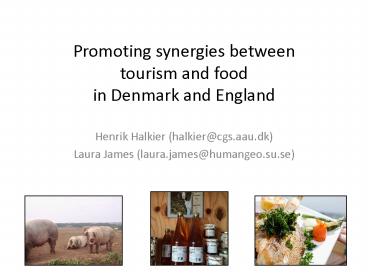
Promoting synergies betweentourism and food in
Denmark and England
- Henrik Halkier (halkier_at_cgs.aau.dk)
- Laura James (laura.james_at_humangeo.su.se)
2
Promoting synergies betweentourism and food in
Denmark and England
- Henrik Halkier (halkier_at_cgs.aau.dk)
- Laura James (laura.james_at_humangeo.su.se)
- Introduction food and tourism synergies
- Practice perspectives
- Institutions and policies
- Reflections
3
Objectives
- To compare the actors and institutions involved
in the food and tourism sectors in North Jutland,
Suffolk and Jämtland, exploring - the adaptation and recombination of existing food
and tourism practices (production, processing,
catering, experience creation, promoting) - the institutions and policies shaping
interactions between the food and tourism sectors
(DMOs, local government, regional development
agencies, LAGs)
4
Food and Tourism
Purpose
Style
Sourcing
Production
FEEDING TOURISTS
Sustenance
Generic
National
Standardized
FOOD TOURISM
Experience
Place specific
Localized
Specialized
travel informed by the desire to experience a
particular type of food or the produce of a
specific region (Hall Sharples, 2003 10)
5
Tourists and food
6
Tempting development prospects
- Food increases attraction/brand of destination
(Richards 2002, Presenza Del Chiappa 2013) - Extending the season (Hall et al. 2003)
- Boost local food production, rural
diversification (Hjalager 2002, Everett Slocum
2013) - Cultural sustainability, heritage and regional
identity (Long 2004, Sims 2009, Telfer
Hashimoto 2013) - Environmental sustainability (Hall Gössling
2013)
7
Two Perspectives
- Institutions Policies
- Rural development (EU? LAGs)
- Destination development (DMOs)
- Economic development (RDAs, Local
Authorities/municipalities) - How do these
- shape existing practices the links between them
- Support (or hinder) the development adaptation,
recombination, transformation, etc
- Practices
- Producing food
- Retailing
- Catering and hospitality,
- Creating experiences
- (Promoting tourism)
- How are existing practices adapted, connected,
transformed? Are new practices being created?
8
Case Study Destinations
- North Jutland (DK), Suffolk (UK)
- Coastal destinations with rural hinterlands
- North Jutland self-catering holiday homes,
Germans, Danes, Norwegians, Swedes - Suffolk Summer/weekends, cottages and 2nd
homes, London and South East - Food tourism ambitions, no magnificent culinary
heritage - Suffolk wheat/barley, poultry, pork,
vegetables - North Jutland grain, milk, pork, seafood
- Interviews with producers, retailers,
restaurants, policymakers
9
2. Practice
- Reckwitz (2002 249) Practice as '...a
routinized type of behaviour which consists of
several elements, interconnected to one another
forms of bodily activities, forms of mental
activities, things and their use, a background
knowledge in the form of understanding, know-how,
states of emotion and motivational knowledge'. - Nicolinis (2012) sensitizing questions/dimensions
of practice - Key and marginal actors, sayings and doings,
practical concerns, temporal organization - A more fine-grained, process-oriented approach
- Not starting with firms, institutions, networks,
policies - What do people do on the ground
10
Food/tourism practicesin North Jutland
- Key practices
- Producing
- Retailing
- Catering
- Promoting
- Two initiatives aiming to promote cross-sectoral
synergies - New signature dishes
- Establish local food market
11
Case Jammerbugt Signature dish
- Adapting existing practices
- fixed items on menus
- story telling
- linking in new ways
- use of local suppliers?
- new practice
- make recipe public
- joint branding
- DMO developing networks
12
Case Hals local food market
- adapting existing practice
- adding food to existing summer Saturday markets
- producers travelling further to participate
- linking in new ways
- local business development and tourism promotion
connected through development of summer food
market - new practice
- DMO developing local product by initiating event
13
Key Findings
- Support for marginalised quality food
production practices, but small scale - Focus on adapting visible practices (menus,
markets) new temporality (outside main season)
rather than localising food chain - Some practices too difficult to change/link
together buying practices of supermarkets and
restaurants - Differences and dependencies between practices
- What is at stake when practices must be changed
or new ones adopted? - Brokers and boundary objects
14
3. Institutions and Policy
- Conceptualising economic/tourism development
strategies - Contextual drivers (destination branding, boost
local food production, food scares) - Available resources (tourism/food,
public/private) - Change strategies (aims, targets)
Food tourism change strategies Food tourism change strategies Primary policy target Primary policy target
Food tourism change strategies Food tourism change strategies Food Tourism
Main level of intervention Firm-level Innovating Developing experience
Main level of intervention Destination Localising consumption Promoting image
15
Strategising food tourism
North Jutland (DK) Suffolk (UK)
Tourism resources Seasonal coastal destination Mainly self-catering families Many grill bars, few high-end restaurants Seasonal coastal destination Mainly self-catering couples Many gastro-pubs, few high-end restaurants
Culinary resources No signature dishes Emerging local quality produce No signature dishes Expanding local quality produce
Private sector resources Some small-scale producers Some small-scale fishing Fragmented tourism sector Many small-scale producers Some small-scale fishing Some larger quality producers Fragmented tourism sector Commercial distribution to/via supermarkets etc.
Public sector resources EU LEADER rural programme Established, well-resourced DMOs EU LEADER rural programme Limited support for private-sector led DMOs
16
Strategising food tourism
North Jutland (DK) Suffolk (UK)
Policy drivers Extension of tourism season Rural development New Nordic cuisine Extension of tourism season Rural development Food scares - provenance
Initiatives Destination branding with food Support for food events (LEADER) food network to link/profile small producers (and restaurants) Signature dishes with local ingredients/story-telling Destination branding with food Support for food events LEADER diversification projects
Challenges New Nordic is urban No joint distribution Limited growth of small-scale quality production Fragmented tourism policy landscape Limited financial resources for promotion
17
Key Findings
- Policies focus on
- Changes visible to visitors branding, events,
menus, (diversification) - New temporality (outside main season)
- NOT localising food chain
- Policy differences reflect
- Perceived/experienced intensity of demand
- Degree of availability of local food (producers,
retailers) - Alternatives to diversification for small farmers
(wage labour) - (National) preferences for particular policy
instruments (networks vs grants) - Long-term strategic weaknesses
- Limited funding for promotion/DMOs (UK)
- Limited addressing of production/distribution
density (DK) - Weak combination of branding AND development in
sector-based governance (DK/UK)
18
4. Reflections and perspectives
- Defining and delimiting practices
- Zooming in and out?
- Relationship between practices and strategies
- Impacts continuity and change?
- Comparing and contrasting
- Different cross-sectoral coordination strategies
(markets, networks, branding?)
Recommended

