

WellOne Primary Medical Care Program for Medical Clinical Staff PowerPoint PPT Presentation
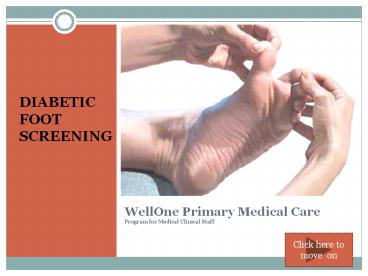
Title: WellOne Primary Medical Care Program for Medical Clinical Staff
1
WellOne Primary Medical CareProgram for Medical
Clinical Staff
- DIABETIC FOOT SCREENING
Click here to move on
2
Diabetes and Amputation
- Diabetes is the cause of over 50 of all the
non-traumatic amputations in the United States. - The risk of ulcers or amputations is increased in
people who have had diabetes gt10 years, are male,
have poor glucose control, or have
cardiovascular, retinal, or renal complications. - The loss of a lower extremity, or even part of a
lower extremity, significantly impacts quality of
life
Click here to move on
Click here to view previous screen
3
True of False Diabetes is the cause of over
50 of all the non-traumatic amputations in the
United States.
- True
- False
Click here to select this answer
Click here to select this answer
Click here to view previous screen
4
The correct answer is
- TRUE
- 5-15 with diabetes will undergo amputation in
lifetime - Thats up to 30 amputations in 200 patients
- About 84,000 people with diabetes have lower
extremity amputations each year (Centers for
Disease Control and Prevention. Diabetes
disabling, deadly and on the rise, 2004..)
Click here to move on
Click here to view previous screen
5
Diabetes and Amputation
- Someone, somewhere, loses a leg because of
diabetes every 30 seconds of everyday..."-
Lancet. 20053661674
Click here to move on
Click here to view previous screen
6
Risk Factors Peripheral Neuropathy (PN)
- High levels of glucose are toxic to the nerves
- Peripheral neuropathy (PN) is damage to the
nerves that connect the spinal cord to the arms
and legs (the peripheral nerves) - PN is the 1 risk factor for diabetic foot ulcer
and amputation
Click here to move on
Click here to view previous screen
7
True of False Peripheral Neuropathy is the 1
risk factor for foot ulcer and amputation.
- True
- False
Click here to select this answer
Click here to select this answer
Click here to view previous screen
8
The correct answer is
- TRUE
- About 60 to 70 of all people with diabetes will
eventually develop peripheral neuropathy,
although not all suffer pain. This leads to
painless trauma, ulceration, infection, and
finally amputation. - Because of the lack of pain, the diabetic with
neuropathy is prone to foot trauma/injury
unawareness. A lack of pain when an ulcer is
noted may lull the patient into a false sense of
security, perceiving the ulcer to be of little or
no significance. Thus, the patient may neglect
and/or delay appropriate treatment for their
problem.
Click here to move on
Click here to view previous screen
9
PN Symptoms
- Symptoms can range from mild to severe and
perhaps disabling. - Sometimes PN is present even without symptoms.
- When people first get PN, they normally feel
sensations like tingling, weakness, numbness,
pinching, buzzing or stiffness in their toes and
feet or fingers and hands. - As it gets worse, people report having a
cramping, burning, throbbing or shooting pain. - Some refer to the pain as "frostbite", "pins and
needles sticking in", "a lit match held to my
foot" or "walking on broken glass". This could be
so severe that wearing clothes or sleeping under
blankets is painful. - Symptoms of PN vary from person to person. They
can appear suddenly, come and go, or persist over
time. They usually affect both sides of the body
at the same time, and they may get worse at
night.
- When the nerves going into the feet are damaged,
sensation is impaired - Normally pain is protective, letting us know
there is a problem. - With PN there may be little to no pain when an
injury has occurred
Click here to move on
Click here to view previous screen
10
Peripheral Neuropathy
Click here to move on
Click here to view previous screen
11
PN Physical Exam Findings
- Decreased ability to feel pressure with
monofilament testing - This is termed an insensate foot
Click here to move on
Click here to view previous screen
12
Risk Factors Peripheral Arterial Disease
- Arterial insufficiency refers to sluggish blood
flow through the arteries. - In diabetes, this is usually due to
atherosclerosis (plaques that line the blood
vessels) - This results in reduced blood flow to the feet
and extremities
Click here to move on
Click here to view previous screen
13
Peripheral arterial disease is usually due to
- Peripheral
- neuropathy
- Nerve damage
- Atherosclerosis
Click here to select this answer
Click here to select this answer
Click here to select this answer
Click here to view previous screen
14
The correct answer is
- Peripheral neuropathy
- Nerve damage
- Atherosclerosis
Click here to select this answer
Click here to learn more select atherosclerosis
from the drop down menu
Click here to select this answer
Click here to select this answer
Click here to move on
Click here to view previous screen
15
PAD Symptoms
- The reduced blood flow (and lack of oxygen to the
tissues) leads to unhealthy tissues and poor
wound healing
- Many people with diabetes and PAD
- do not have any symptoms. Some
- people may experience mild leg pain
- or trouble walking and believe that
- its just a sign of getting older. Others
- may have the following symptoms
- leg pain, particularly when walking or
exercising, which disappears after a few minutes
of rest (clinical term is intermittent
claudication) - numbness, tingling, or coldness in the lower legs
or feet - sores or infections on the feet or legs that heal
slowly
Click here to move on
Click here to view previous screen
16
The clinical term for leg/calf pain that occurs
with activity and disappears with rest is
- Peripheral arterial
- disease
- Intermittent
- claudication
- Peripheral
- Neuropathy
Click here to select this answer
Click here to select this answer
Click here to select this answer
Click here to view previous screen
17
The correct answer is
- Intermittent claudication
Click here to move on
Click here to view previous screen
18
PAD Physical exam findings
- On physical exam, persons with peripheral
arterial disease may have - Weak or absent pulses in lower extremities
(pedal pulse) - Coolness of the foot or leg
- Shiny skin with or without stasis dermatitis
- Hair loss (on the legs and toes)
- Toe nail changes (brittle, thickened)
Red to brownish discoloration, known as stasis
dermatitis.
Click here to move on
Click here to view previous screen
19
A red/brown discoloration of the lower
extremities that is seen with arterial disease is
termed
- Stasis Dermatitis
- Intermittent
- claudication
- Peripheral
- Neuropathy
Click here to select this answer
Click here to select this answer
Click here to select this answer
Click here to view previous screen
20
The correct answer is.
- Stasis dermatitis
Click here to move on
Click here to view previous screen
21
PAD Risk Factors or developing
All of these increase the risk of PAD
- Smoking
- High blood pressure
- High cholesterol Overweight/Obesity
- Physical inactivity
- Poor control of blood glucose
Click here to move on
Click here to view previous screen
22
All of the following are signs of arterial
disease except
- Cool extremities
- Diminished pedal
- pulses
- Loss of sensation
- Decreased hair growth
Click here to select this answer
Click here to select this answer
Click here to select this answer
Click here to select this answer
Click here to view previous screen
23
All of the following are signs of arterial
disease except
- Cool extremitites
- Diminished pedal pulses
- Loss of sensation
- Decreased hair growth
Cool extremities, decreased hair growth and
diminished pedal pulses are seen with PAD,
whereas loss of sensation occurs with peripheral
neuropathy
Click here to move on
Click here to view previous screen
24
Risk Factor Obesity
- Obesity is a risk factor for diabetic foot
disease because - There is more weight and shear stress on the feet
- Obese persons may have a difficult time
inspecting and caring for their feet
Click here to move on
Click here to view previous screen
25
Risk Factor Foot Deformity
- Foot deformities, such as
- bunions, hammer toes,
- claw toes, etc. lead to areas
- of increased
- friction and
- pressure
Bunion
ULCERATION
Click here to move on
Click here to view previous screen
26
Additional Risk Factors
- Impaired vision
- Poor glucose control
- Poor footwear
- Decreased mobility
- Severe nail pathology
- History of foot ulcers or amputation
Click here to move on
Click here to view previous screen
27
These nails are hypertrophied (thickened) from
fungal infection in this patient with no prior
access to podiatric care. Due to the increased
pressure transmitted to underlying tissues, these
nails can damage the nail bed which may then
become secondarily infected and ulcerate.
Click here to move on
Click here to view previous screen
28
The Diabetic Foot Exam
- Also known as the LEAP Exam
- LEAP is an acronym for
Lower Extremity Amputation Prevention
Click here to move on
Click here to view previous screen
29
LEAP PROGRAM
- The LEAP Program consists of five relatively
simple activities - Foot screening
- Patient education
- Daily self inspection of the foot
- Appropriate footwear selection
- Management of simple foot problems
Click here to move on
Click here to view previous screen
30
Who
should have a diabetic foot screening?
- The Bureau of Primary Health Cares (BPHC) Lower
Extremities Amputation Program (LEAP) recommend
visual foot exams / inspections at each visit. - All patients with diabetes should have a
monofilament test done at least annually.
Click here to visit the BPHC/HRSA website
Click here to move on
Click here to view previous screen
31
True of False A visual foot exam should be
performed at every visit with a diabetic patient
- True
- False
Click here to select this answer
Click here to select this answer
Click here to view previous screen
32
The correct answer is
- True
Click here to move on
Click here to view previous screen
33
Level I Diabetic Foot Screening Step ITalk with
the patient and document responses
- Have there been any changes in your feet?
- How often do you examine your feet for changes?
- Any burning, numbness, tingling, or pain in your
feet or calves? - Is there pain in the calf muscles when walking?
- Do you smoke?
Click here to move on
Click here to view previous screen
34
Burning, numbness and/or tingling in the feet may
indicate
- Peripheral Neuropathy
- Arterial Insufficiency
- Diabetic nephropathy
- Stasis Dermatitis
Click here to select this answer
Click here to select this answer
Click here to select this answer
Click here to select this answer
Click here to view previous screen
35
The correct answer is
- Peripheral Neuropathy
- Arterial Insufficiency
- Diabetic nephropathy
- Stasis Dermatitis
Click here to move on
Click here to view previous screen
36
Level I Diabetic Foot Screening Step II Perform
a visual screening of footwear and lower
extremities
- Explain to the patient that you will be
performing a foot screening - Ask the patient to remove both the shoes and
socks - Inspect the shoes for signs of excess wear and
the presence of objects such as pebbles, sharp
areas, etc - Visually inspect the lower extremities- paying
particular attention to look between the toes and
the back of the heal. Feel for the temperature
and condition of the skin. - Note any deformities and skin problems
Calloused areas
Redness and pressure areas
Deformity
Edema
Dry, cracked skin
Tight Shiny Skin
Click here to move on
Click here to view previous screen
37
The visual portion of the diabetic foot screening
includes inspection of
- Footwear and socks
- Areas between the toes
- The heels of the feet
- All of the above
Click here to select this answer
Click here to select this answer
Click here to select this answer
Click here to select this answer
Click here to view previous screen
38
The correct answer is.
- All of the above
Click here to move on
Click here to view previous screen
39
Level I Diabetic Foot Screening Step III
Perform the monofilament screening
- Explain exam and demonstrate on hand
- Position for comfort
- Have patient close their eyes. Ask patient to
say yes when they feel filament - Touch monofilament to testing area, creating a C
shaped bend and remove avoid dragging avoid
calloused areas
Click here to move on
Click here to view previous screen
40
The Monofilament Screening
- Is used to determine if there is loss of
protective sensation (LOPS) - A lack of sensation in any area with monofilament
screening means the patient is at increased risk
of foot ulceration and this usually prompts the
health care practitioner to refer the patient to
a podiatrist
Click here to move on
Click here to view previous screen
41
What is the preferred way to establish if the
patient feels the monofilament?
- Tell the patient to let you know when he/she
feels the sensation - Ask the patient to blink 3 times when he/she
feels the sensation - Ask the patient Do you feel this?
Click here to select this answer
Click here to select this answer
Click here to select this answer
Click here to view previous screen
42
The correct answer is.
- Tell the patient to let you know when he/she
feels the sensation. This avoids the examiner
prodding the patient to report the sensation.
If the patient does not respond to the
monofilament, the examiner should note negative
sensation in the area and move on with the
screening.
Click here to move on
Click here to view previous screen
43
True of False The proper amount of pressure
for monofilament testing is that which causes an
indentation to be left in the skin.
- True
- False
Click here to select this answer
Click here to select this answer
Click here to view previous screen
44
The correct answer is..
- Falsethe correct pressure is applied by
touching the monofilament to the testing area and
creating a C shaped bend.
Click here to move on
Click here to view previous screen
45
MONOFILAMENT SCREENING
- A simplified monofilament examination using only
4 sites per foot (total 8 sites) detected 90 of
patients with an abnormal 16-site monofilament
evaluation. - J Gen Intern Med. 1999 July 14(7) 418424. doi
10.1046/j.1525-1497.1999.05208.x.
Click here to move on
Click here to view previous screen
46
- The 4 test sites
Click here to move on
47
Prior to performing the monofilament screening,
it is important that the examiner
- Demonstrate the
- monofilament on the
- Patients hand or arm
- Lubricate the
- monofilament
Click here to select this answer
Click here to select this answer
Click here to view previous screen
48
The correct answer is
- ..Demonstrate the monofilament on the
patients arm or hand - This lets the patient know that the monofilament
does not hurt and what the monofilament is
suppose to feel like.
Click here to move on
Click here to view previous screen
49
Throughout the screening and following the
screening.Provide patient education
- Awareness of personal risk factors
- Daily self inspection of feet
- Proper nail and skin care
- Injury prevention
- When to seek help or specialized referral For a
foot finding call immediately do not delay - Never walk barefoot
- For a foot finding call immediately do not delay
- Smoking cessation
- Check water temperature for bathing
- Moisturize but not between toes
- Proper foot wear selection
Click here to move on
Click here to view previous screen
50
Education and Goal Setting Is Important
- It is estimated that the risk of diabetes-related
foot complications can be reduced by 49 to 85
by proper preventive measures, patient education,
and foot self-care. - (Apelqvist J, Bakker K, van Houtum WH,
Nabuurs-Franssen MH, Schaper NC. International
consensus and practical guidelines on the
management and the prevention of the diabetic
foot. International Working Group on the Diabetic
Foot. Diabetes Metab Res Rev. 200016S84S92.)
Click here to move on
Click here to view previous screen
51
Lastly, Be sure to..
- Document all findings and education
- Verbally report findings to the PCP
Click here to view previous screen
Click here to move on
52
You have reached the end of this program..
- Once you are confident that you are comfortable
with all the materials presented, proceed to the
Diabetic Foot Screening post-test at
http//www.classmarker.com/professional/ - Your username is the first initial of your first
name followed by your full last name. Your
password is nwhealth
Click here to go back and review previous slide
Start Over
Exit
Recommended

