

5. Religious Attitudes to Rich and Poor in British Society. PowerPoint PPT Presentation
1 / 18
Title: 5. Religious Attitudes to Rich and Poor in British Society.
1
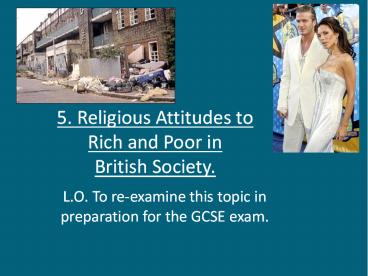
5. Religious Attitudes to Rich and Poor in
British Society.
- L.O. To re-examine this topic in preparation for
the GCSE exam.
2
Overview
- You need to know and be able to discuss
- Why people are rich/poor in the UK
- Sources of personal wealth
- Religious attitudes to money and the personal use
of wealth - Religious attitudes to responsibility for the
poor - How and why religious people help the poor in the
UK - How the state tries to help the poor in the UK
- Whose actual responsibility it is to help the
poor in the UK - Whether it is right to gamble in general and
whether it is right to gamble on the lottery - How the lottery has created wealth in the UK.
3
Christian Attitudes to Wealth and Poverty Sikh Attitudes to Wealth and Poverty
Jesus told the rich man to sell all he had and follow him, the man could not do this. Jesus praised a tax collector who decided to give half his wealth to the poor and compensate four times the amount he had cheated from people. Paul said the love of money is the root of all evil. (Not money itself). There is nothing wrong with being rich it is how people use their wealth and their attitude to possessions that matter. Being rich should be seen as an opportunity to be generous rather than a cause for pride. Christian employers should create good conditions of employment, pay fair wages and not make profits by unjust means. Some Christians accept the lottery if money raised goes to good causes but others think it just encourages greed and gambling addiction. The Salvation Army is one Christian organisation that helps the poor in very practical ways. Love your neighbour as yourself Luke 1027 Wealth in itself is not wrong it is a reward for the previous life (Law of Karma) Poverty is not essential to goodness. The wealthy have a duty to help those less fortunate and give what they can dasvandh. This is related to the idea of sewa selfless service to God by helping others. Guru Nanak taught the importance of honest work. Gambling is not looked upon as earning your living honestly and so it is not encouraged. Also they will not bid for lottery funding to help with projects for the Gurdwara or the Sikh community in general. Sikh employers have a duty to give employees good working conditions and fair wages. Guru Amar Das said, Blessed is the godly person and the riches they possess because they can be used for charitable purposes and to give happiness. Gods bounty belongs to all, but in this world it is not shared justly. Guru Granth Sahib
4
Key words to learn for this topic
- Rich
- Poor
- Money
- Wealth
- Poverty
- Charity
- Inheritance
- Wages
- Homelessness
- Apathy
- Gambling
- Addiction
- Counselling
- Minimum wage
- Excessive salary
- Responsibility
- Community
- Lottery
5
Some Important Definitions
- Inheritance When a friend or family member
leaves you money or property in their will when
they die. - Excessive salaries also known as fat cat
salaries, large amounts of money earned, plus
possibly bonuses and share options. - Poverty Trap not being able to break out of
poverty. - Minimum Wage the legal minimum amount which
must be paid to a worker in the UK.
6
Who are the Rich and the Poor?
The UK includes very rich people and very poor
people as well as the vast majority who fall
between these two extremes. The rich have
acquired or inherited wealth in the form of
money, possessions and investments. They have
more money than they need to provide the basic
necessities such as food and a home. Their lives
are comfortable and they have few financial
worries. On the other hand anyone living in
poverty struggles to afford food and the basic
necessities for themselves and their family. Some
will have a home, but it may not be suitable and
they may be behind with their rent or mortgage
payments. Others will be homeless, whether
through difficult circumstances or because their
own choices have led to that situation. Many
people would prefer there to be less of a
difference between the rich and the poor. But
complete equality is very likely to remain an
ideal. Communist philosophy attempts to close the
gap between rich and poor but other people think
that complete equality is not desirable.
7
Do you think it is morally right for some people
in Britain to earn excessive salaries (fat
cat)whilst others live in poverty?
Marry a rich spouse and share their wealth.
Receive relative wealth through gifts, e.g. from
older members of the family.
Born into a wealthy family, or inheritance.
Having a talent that pays a good salary e.g. film
or football star
Working hard and long hours e.g. doctor or built
up a healthy business
Causes and Sources of Wealth
Winning the lottery - It has made over a thousand
millionaires.
Inventing a new product or creating a popular
song or piece of art.
Investing in stocks and shares or savings
8
Why are some people Poor?
Which of these would you say is the most common
cause of poverty in Britain?
Illness or Disability
Poor education or lack of skills
Unemployment
Low wages (at or slightly above minimum wage)
Homeless
Too lazy or apathetic to work
Large credit card bills
Too big mortgage
Tobacco
Alcohol
Debt (Financial mismanagement)
Wasteful spending patterns
Loan repayments
Drugs
Gambling
Investments going wrong
9
Breaking Free From Poverty
Getting the right advice careers advisers,
Connexions service, Citizens Advice service.
Education and Training, both at school and beyond
with vocational courses, adult literacy and
numeracy courses etc.
Government help since 1999 there is the minimum
wage. Also state benefits to help individuals and
families unemployment, invalidity benefit, tax
credits and pensions for the elderly etc.
However, many extremely poor people in Britain
cannot escape the POVERTY TRAP. They may live in
socially deprived areas or on the streets.
Without resources or confidence, they find that
getting an education, qualifications, skills and
a good job is just too difficult.
10
Local Authorities have a responsibility to care
for the poor and vulnerable in the community.
They provide social workers, advisers, support
workers. They also provide rented accommodation
Families may help each other in difficult times
but it is not always possible. Sometimes a
breakdown in the family may be the cause of the
poverty. On the other hand a poor family can
still be a loving and happy family unit.
Who Cares?
Charities offer practical support to the poor,
including redistributing second-hand clothes and
household goods to families in need, supporting
children e.g. NSPCC the elderly e.g. Age UK.
Some charities like the Salvation Army are run by
religious organisations.
11
Salvation Army run hostels, soup runs, advice,
clothing etc.
Three Charities that help the Poor in the UK
Crisis run emergency shelters, advice and soup
runs.
Shelter provide housing, advice and campaigning
12
Lotto the National Lottery
- On 19th November 1994 the first National Lottery
in the UK was drawn. It was set up to give people
the chance to become rich beyond their wildest
dreams and to help good causes. - Over the years it has grown to have more draws
and also the introduction of scratch cards as
well as a European lottery draw (Euromillions). - Despite its popularity it has gained many
critics.
13
Money to Good Causes
- For every 1 staked on Lotto 28 pence is given to
good causes. Over 21billion have been
distributed to these good causes. This money has
to be bid for and there are strict rules about
who or what can benefit. There are four
categories - Arts (16.67)
- Heritage (16.67)
- Sport (16.67)
- Health, education, the environment and charities
(50)
14
Arguments for and against the Lottery
- Arguments For
- Arguments Against
- Over 1,000 people have become millionaires since
it began - It benefits many charities and good causes
- Grants are given to preserve religious buildings
- Grants are given which help the community
- It is gambling and can lead to addiction
- It encourages greed
- The gain is achieved by others losses
- Those who buy tickets are generally those who can
least afford it - Any gain depends on chance and is not earned
through work or commitment
15
Religious Attitudes to the National Lottery
- Buddhist, Hindu, Jewish, Islamic and Sikh
teachings forbid any form of gambling, including
the National Lottery, as it is seen as a way of
earning money that does not involve doing honest
work, and can promote greed and encourage
laziness. For every person who becomes richer as
a result of gambling, many others become poorer.
These five religions will not bid for lottery
funding for projects supported by their faith.
The Guru Granth Sahib says He alone has found
the right way who eats what he earns through toil
and shares his earnings with the needy. - Some Christian denominations share these views on
gambling (E,g, Methodists), but others such as
Roman Catholics and Church of England, while not
actively encouraging gambling, will allow
believers to gamble in moderation. Christian
charities have used the good causes fund from the
Lottery and the Heritage Fund has helped with the
upkeep of churches and cathedrals. Proverbs 234
says Do not wear yourself out to get rich have
the wisdom to show restraint.
16
Religious Teachings on Wealth and Poverty
- All religions teach
- Every person should be valued and treated with
respect and care - Wealth is not wrong it is how it is acquired and
used that is important exploiting others, greed
and selfishness are wrong - Workers should receive a fair wage and prices for
goods sold should be fair - Spiritual riches are more important than material
riches what matters is what a person does with
their wealth, not how much they have. All
religions expect rich people to use their wealth
to help others. - Responsible use of wealth is another way in which
people can reach their spiritual goals.
17
Christian Attitudes to Wealth and Poverty Sikh Attitudes to Wealth and Poverty
Jesus told the rich man to sell all he had and follow him, the man could not do this. Jesus praised a tax collector who decided to give half his wealth to the poor and compensate four times the amount he had cheated from people. Paul said the love of money is the root of all evil. (Not money itself). There is nothing wrong with being rich it is how people use their wealth and their attitude to possessions that matter. Being rich should be seen as an opportunity to be generous rather than a cause for pride. Christian employers should create good conditions of employment, pay fair wages and not make profits by unjust means. Some Christians accept the lottery if money raised goes to good causes but others think it just encourages greed and gambling addiction. The Salvation Army is one Christian organisation that helps the poor in very practical ways. Love your neighbour as yourself Luke 1027 Wealth in itself is not wrong it is a reward for the previous life (Law of Karma) Poverty is not essential to goodness. The wealthy have a duty to help those less fortunate and give what they can dasvandh. This is related to the idea of sewa selfless service to God by helping others. Guru Nanak taught the importance of honest work. Gambling is not looked upon as earning your living honestly and so it is not encouraged. Also they will not bid for lottery funding to help with projects for the Gurdwara or the Sikh community in general. Sikh employers have a duty to give employees good working conditions and fair wages. Guru Amar Das said, Blessed is the godly person and the riches they possess because they can be used for charitable purposes and to give happiness. Gods bounty belongs to all, but in this world it is not shared justly. Guru Granth Sahib
18
(No Transcript)
Recommended

