

Chapter 2 Activity 3 Page 120 Solutions, Suspensions, and Colloids PowerPoint PPT Presentation
1 / 14
Title: Chapter 2 Activity 3 Page 120 Solutions, Suspensions, and Colloids
1
Chapter 2 Activity 3
Page 120Solutions, Suspensions, and
Colloids
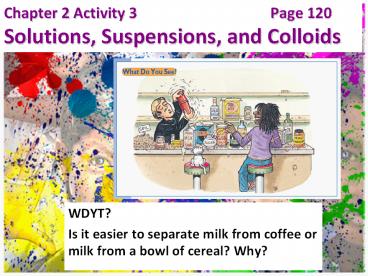
- WDYT?
- Is it easier to separate milk from coffee or milk
from a bowl of cereal? Why?
2
Investigation
- Investigate
- You have 30 minutes to complete the activity
- Half fill six test tubes with water. Number the
test tubes. - Create a table like the one below
Material mixed with water Observations before mixing Homogeneous or heterogeneous Effect on laser beam Passes through filter paper
1
2
3
3
Chemistry In ActivityChem Saver Page 13
- Classifying Matter
- Pure Substance
- one kind of particle throughout
- Element
- Compound
- Mixtures
- Two parts
- Solute
- Solvent
- Homogeneous
- Totally uniform throughout
- Heterogeneous
- Particles separate after mixing
4
Chemistry In ActivityChem Saver Page 13
Solution Suspension Colloid
Heterogeneous/ Homogeneous Homogeneous Heterogeneous Heterogeneous
Particle size Small Large Medium
Pass thru. Filter paper Yes No yes
Tyndall Effect No Yes yes
5
Homogeneus mixtures
- Homogeneous mixtures is a mixture in which the
components are evenly distributed among each
other. You cant see the component parts. - Homo means the same throughout.
- It has a constant composition throughout.
- Homogenous mixtures are also
- called SOLUTIONS
Examples Salt dissolved in water, sugar
dissolved in water, apple juice, tea, copper (II)
sulfate solution in water, alloys....
6
Solutions
- Well-mixed (uniform) single phase
- homogeneous
- transparent
- cannot be separated by filter
- do not separate on standing
7
(No Transcript)
8
heterogeneous mixtures
Heterogeneous mixture the components are not
evenly distributed among each other. An
heterogeneous mixture has two or more distinct
phases that are usually detectable. This type of
mixture does NOT have uniform properties. Heteroge
neous mixtures that look like solutions can be
distinguished because they scatter light
(Tyndall effect).
Examples Sand water, oil and water, milk, sulfur
and iron, granite, blood...
9
Suspensions
- A suspension of liquid droplets or fine solid
particles in a gas is called an aerosol. In the
atmosphere these consist of fine dust and soot
particles, and cloud droplets. - suspension system does not stays stable and
settle - Examples of Suspensions
- Mud or muddy water, is where soil, clay, or silt
particles are suspended in water. - Flour suspended in water
- Paint
- Chalk powder suspended in water.
- Dust particles suspended in air.
- Algae in water
- Milk of Magnesia
10
- Suspensions like coffee are easily filtered to
take out the tiny solid clumps floating in the
liquid.
- In colloids and many homogeneous mixtures have
clumps that are so small they pass through most
filters.
11
Colloids
non transparent, non uniform, large particles,
cloudy (milky) but stable system
12
Colloids
Tyndall effect You can see the light passes
through a colloid. (particles scatter light.)
emulsion a mixture of immiscible substances
(liquid-liquid). like milk and mayonnaise
13
WDYTN?
- At the beginning of this activity you were asked
- Is it easier to separate milk from coffee or milk
from a bowl of cereal? Why? - Use what you know to develop a procedure to
separate a mixture of salt, sand, and iron
filings. Think about the following - Which item is magnetic and how would you remove
it from the mixture? - What will dissolve in water and pass through a
filter? - What item is not magnetic and will not dissolve
in water?
14
Independent Work
- Chem Essential Questions
- Questions 1 - 4
- Be sure to answer all parts of the question in
complete sentences.
Recommended

