

You are Going to Learn to Play the Recorder! PowerPoint PPT Presentation
Title: You are Going to Learn to Play the Recorder!
1
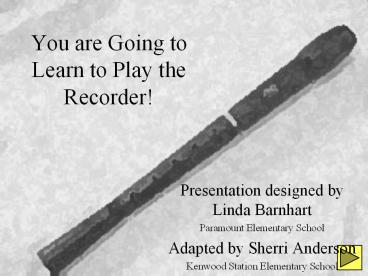
You are Going to Learn to Play the Recorder!
- Presentation designed by Linda Barnhart
- Paramount Elementary School
- Adapted by Sherri Anderson
- Kenwood Station Elementary School
2
Note to Parents
Note to students
This presentation was designed to help you learn
to play the recorder. You move through the
lesson by clicking the mouse to move from slide
to slide. Click on the symbol to play
sound clips. Take your time to read and practice
each slide. You should be able to play a song on
the recorder when you finish this lesson.
Some times students come in the middle of the
year or havent had previous experience with the
recorder like their classmates and it makes it
difficult to catch them up on the recorder. This
presentation was developed to help with that
problem. It introduces the student to the
recorder and gets them started. I do not
normally move this quickly in the classroom, but
here the student can practice and repeat the
lesson as necessary. I hope that you will find
this a helpful tool.
3
Recorder
- Essential Questions
- How do composers/musicians use the Elements of
Music in creating and performing music? - How do musicians create and notate music?
- How do musicians perform and improvise music?
- Guiding Questions
- What is a recorder?
- What instrument family does a recorder belong to?
- How do I play a soprano recorder using correct
playing techniques? - How do I apply what I learned about melody to the
recorder? - How do I care for my recorder?
- What are the 7 elements of music and what do they
mean? - Why do musicians need to read music notation?
4
Daily Expectations
- Sit in new spot in your rows from day 1
- Have your recorder out and ready to go if youve
brought it from home or wait patiently for folder
passers to pass yours out to you. - Have your recorder and recorder book/folder out
and ready to go - You may practice until I am in front of the class
for Give me 5 then your recorder needs to be in
the listening position. - Any of the following will result in signing the
book - You forget your recorder or book at home
- If playing while in the listening position
- If overblowing/making squeaking sounds on
purpose - If your right hand remains on top after two
reminders - Signing the book more than once will mean having
a consequence in your classroom, too.
5
This is a soprano recorder
This is a halo holder that we use to hang the
recorder around our necks.
You can make one using yarn or string if you
dont have one or lose yours.
6
Your Recorder Comes with a cleaner.
- Students need to clean their recorders using the
rod after they play to remove moisture thats
built up on the inside of the instrument. - To do this properly, you need to add a small
strip of cloth to the rod to use it to clean (not
tissue or paper towel, thin cloth works best). - Many students end up with too big a strip of
cloth and the rod gets stuck in the recorder, so
be careful! - You may also clean it using mild dish detergent
in warm water or in the dishwasher (top rack). - The part that you need to clean most is the
mouthpiece. - This rod does not clean the mouthpiece.
7
To Clean Your Recorder (during a practice
session)
- Turn the recorder so that the thumb hole is away
from your body - Cover the area below the mouthpiece with your
thumb and give a quick blow into the mouthpiece.
(If you do this correctly you should not hear
it.) - Wipe off any moisture that is on your thumb and
repeat two more times. - OR
- Quick Fix cleaning Put your mouth on the
recorder and suck in (dont blow out).
8
Joint Grease
Your recorder also comes with a small container
of joint grease. - Only use this on the
part of the recorder where the two pieces join
together (the joint) - You only need to use it
when it is hard to pull your recorder apart or
hard to put it together - Put just a little bit
on your finger then rub around the joint until
greased. - Do NOT use it as lip gloss or put it
on any other part of your body.
9
The Recorder has been around for a long time.
- The recorder was very popular in Europe in the
1500s and 1600s. It was then almost forgotten
until the early 1900s, when instrument maker
Arnold Dolmetsch became interested in it. Through
an accident his recorder was lost. Luckily, he
had taken careful measurements and based a new
instrument on the old design. This was the
beginning of a revival for the recorder. 1
1. Taken from the Kingfisher Young Peoples Book
of Music 1996
10
The 3 Recorder Positions
- 1. Listening Position in your lap, hanging
around your neck, or on the floor (completely
away from your mouth!) - 2. Practice Position on your chin, fingering the
correct notes (not able to make sound if doing it
correctly) - 3. Playing Position In your mouth ready to play
(wait for instruction if playing together as a
whole class)
11
This is a little song to help you learn how to
hold the recorder.
- The recorder in your right hand is where we will
begin... - Be sure to hold the bottom and move it to your
chin
12
- With your left hand give a thumbs up.
- On the back it must go.
13
Add 1 its B
Add 2 its A
Add 3 its G you know!
14
Proper Hold
1.Open your mouth 2. Set your recorder in between
your teeth 3. Bite down (not hard) with your
teeth on the top and bottom of the mouth
piece 4. Close your mouth around the recorder
This is the proper way to hold the recorder.
This is too high.
This is too low
15
Cover the Holes Completely
It is important to completely cover the hole with
your finger!If you dont, air will escape and
you will squeak.
This hole is completely covered and no air can
escape.
This hole has a small place where air is
escaping.
If you are covering the holes correctly you will
see small round bubbles on your fingers.
16
Proper sound production
There is a correct way to blow into a recorder.
- First, you should blow GENTLY. Think about
blowing bubbles. - You should start the sound with your tongue. Put
your - tongue on the roof of your mouth behind your
teeth. The sound - should start and stop there.
- Some people think of saying the sound tu or
du when they play, - but be careful not to vocalize the sound and end
up saying it out loud.
The lower you go.....
The softer you blow!
Listen to this sound produced correctly.
Listen to this sound that is not produced
correctly.
Can you hear the difference?
17
How to play B
- Wave your left hand at me
- Make an L with that hand.
- Cover the thumb hole on the backside of your
recorder with your left thumb. - Next cover the top hole on the front side of the
recorder (use the pads of your fingers, not the
tips) - You are now ready to play the note B, blow
gently!
Play four short Bs. It should sound like this.
This is what B looks like on the treble clef
staff.
18
How to play A
- Cover the thumb hole on the backside of your
recorder with your left thumb. (left hand on top) - Next cover the top two holes on the front side of
the recorder. - Blow gently. This note is A!!
- From B, youre adding one finger from the left
hand on the next hole.
Play four short As. It should sound like this.
This is what A looks like on the treble clef
staff.
19
How to play G
- Cover the thumb hole on the backside of your
recorder with your left thumb. - Next cover the top three holes on the front side
of the recorder. - Blow gently. This note is G!!
- From B, you add two fingers on the next two
holes. - From A, you add one finger on the next hole.
Play four short Gs. It should sound like this.
This is what G looks like on the treble clef
staff.
20
Music is written on the Staff
This is a staff
This is a Treble clef
For the recorder we play in the Treble Clef
21
The staff is made up of five lines
These lines are labeled E G B D
F
We use many silly sentences to remember these
Every Good Boy Does Fine Empty Garbage Before
Dad Flips (we use this one in class) Every
Gorgeous Babe Does Flirt Elephants Get Big Dirty
Feet Elvis Goes Belly Dancing Fridays
22
The staff has four spaces.
These space notes are labeled F A
C E
23
How do you read music on the staff so you can
play the recorder?
- You must first be able to play the rhythm
- ? A quarter note (ta) is 1 beat of sound and
is faster than a half note or whole
note. - ? A half note (two-oo) is 2 beats of
sustained sound and is faster than a whole
note. - ? A whole note (Fo-o-o-ur) is 4 beats of
- sustained sound.
- ? A set of eighth notes are faster than a
quarter note and are divided
evenly within 1 beat (2 sounds
ti-ti) - ? make sure your tempo stays steady throughout
the piece of music. - Now youre ready to play a song on your recorder
by reading music on the staff.
24
Now Play B-A-G
The pattern we are going to play is quarter,
quarter, half note or ta, ta, two-oo. It sounds
like this On the staff it looks like this
B A G
25
Repeat that phrase.
A phrase is a musical sentence.
B A G
26
Now for the third phrase.
We will play four gs, then four as. These
notes are eight notes and we count them
ti-ti-ti-ti ti-ti-ti-ti. It will sound like
this And it will look like this
27
Play the 4th phrase.
B A G
28
You just played your first song!
Hot cross buns!
The song is HOT CROSS BUNS and the whole thing
looks like this Click here to hear the whole
song
Hot cross buns!
One a pen - ny, two a
pen- ny,
Hot cross buns!
29
Practice this until you can play it!
Hot cross buns!
Hot cross buns!
One a pen - ny, two a
pen- ny,
Hot cross buns!
30
Congratulations!
- Now youre ready to play some songs using B, A,
and G.
31
Now lets review what youve learned.
Staff
This is called a _______
A staff is made up of _____ lines.
5
This is called a __________
Treble clef
This note is a _____
B
This note is a _____
A
This note is a _____
G
A phrase is ________________
a musical sentence
32
Review the notes on the recorder
Three fingers and the thumb play what note? ______
G
Two fingers and the thumb play what note? ______
A
One finger and the thumb Play what note? ______
B
33
You have learned a lot!
Way to go!
Now you can go play your song for your teacher
and you are ready to really get started with the
recorder!
34
Questions??
- Can I take my recorder and recorder book home ?
- Yes, as long as you bring it back to school the
next day and are prepared for class. - You will sign a contract on the board if you
decide to take yours home. - Do I have to take my recorder or recorder book
home? - No, although it is good to practice your skills
so you will become a better musician. - If I take my recorder home does the book have to
go too? - No, but again, it is good to practice the skills
we have worked on in class. - What is a practice bug?
- A slip of paper that has a caterpillar on it.
Each part of its body is worth 10 minutes of
practice time at home. You may get it initialed
after practicing 10 minutes (if you practice 20,
then get two signed off that night). Once you
have filled the entire body, turn it in to me
(signed at the bottom with your name on It) and I
will place it on the recorder board and give you
an extra check towards the treasure box. It is
not mandatory! You may get a practice bug from
the folder on the bulletin board any time you
need one, even if youre not in music. - What are the beads and pipe cleaners for?
- You will have some practice time in class.
During this time, when you feel ready to play a
pass off song for me, I will listen to you or
your group and determine if you have played the
song well enough to pass it off. Each pass
off song will be marked in your book with a star
() or a star and the word BONUS (BONUS). Each
song will earn you a specific colored bead based
on its difficulty. For the bonus songs, you
will earn a glow in the dark bead, silver bead,
or gold bead because they are more challenging.
For each song you pass, you will earn a bead to
put on your pipe cleaner and show off your talent
and I will sign off the song on your sheet. I
will use this to assess how well you are
progressing on the recorder. If you dont pass a
song on the first try, I will tell you some
things to work on and come back later. Every
time you play for me or the class, you can earn a
bead for passing off a song.
Recommended

