

Types of paper (CS Education) PowerPoint PPT Presentation
Title: Types of paper (CS Education)
1
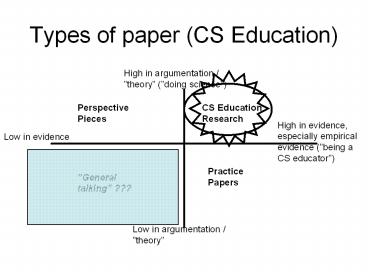
Types of paper (CS Education)
High in argumentation / theory (doing science)
PerspectivePieces
CS Education Research
High in evidence, especially empirical evidence
(being a CS educator)
Low in evidence
Practice Papers
General talking ???
Low in argumentation / theory
2
Two (2½½) important positions
- Carl Popper (1959)
- Scientific hypotheses are by definition refutable
(Kant Analytical apostori). We try to find ways
of falsifying it, but if we dont succeed, the
hypothesis is strengthened. - Other findings and claims arequasi-science
- But is this rigor necessary for practical
purposes? - Thomas Kuhn (1970)
- Science and society always have a set basic
believes that are taken for grated (paradigms)
we are normally not able to break out of these
in our thinking and in our science. - During history, there has been a lot of shifts of
paradigms. - Others claim that there is a countinous stuggle
between different paradigms, and often unclear
which ones are the most dominant today (e.g.
Brian Fay Contemporary Philosophy of Social
Science). - gt
- Kant Syntetic apriori stable, obvious
knowledge, totally the paradigms - Kuhn paradigm shifts
- Fay and others translation of paradigms,
parallel, compeating paradigms
3
Scientific method vs. Method of Science
- Some reseachers distinguish between
- Scientific Method in the Popper sense which
in fact must conclude that we never know for
sure. - Metod of Science in a less strict sense, where
articulation / formulation of the hypothesis may
play a crucial role, and the results are well
enough established (supported by evidence) to be
used in practice.
4
Method of Science inductive vs deductive
approach
- Induction
- questions
- Identification of regularities
- general theory
- utility
- Practical questions, good enough answers
- Often qualitative reseach
- Deduction
- answers
- method of testing hypothesis
- scientific method
- replicability/repeatability
- Strengthen the belief on the answer I think I
have - Quantitative research
Note
5
Hard vs. soft aspects of a science
- Biochemistry vs. social medicine
- Natural vs. social geography
- Electronics vs. sosioinformatics
- Child psychology vs. philosophy of eduacation
- This means the different methodology is used in
different parts of a disipline. - Is informatics one or two sciences?
- Some claim that only the hard part is real
science, indisputable knowledge.
6
Epistemology (theory of knowledge)
- The field includes questions like
- what is knowing?
- how do we know what we (think we) know?
- the backgroud for scientific research
- is knowledge sharable?
7
The more philosopical questions (not adapted
from the book)
- What is truth (if any) ?
- Is there any objective truth, independent,
outside us? - Or are all truths subjective, constructed
within us? - Are they, then, sharable at all?
- Must we trust a kind of intersubjective, common
understanding, or a kind of things inner
beeing (German Sein) ref. Aristotle.
8
Theories
Empirical laws repeatable, quantitative
Explanatory theoriesoften fewer, but deeper
experiments/interviews, evidence based.
and/ormany dimentions
General talking with no evidence, general
description
natural social
science cause and effect.
9
Models
- of something else
- simplified version of something, i.e. things are
left out (may not be a value-free choise) - types of model (e.g.)
- physical models
- mental models
- written models
- graphical models
- purpose of a model (e.g.)
- perform a study, i.e. to check a theory
- explain a procedure
- explain a relationship, i.e. between things
- explain / illustrate a theory
10
Note
- A theory, a scientific law or a model is
different from the phenomena it describes, and
is, as such not observable (David Hume). - Some theories are deterministic, in the sense
that it must be such or such - Others are probalistic
- Others pre-supposes that man may behave
different, that man has a kind of free will.(A
stone cannot decide i.e. not to fall, but a
person may decide i.e. not to drive a car). - The perfect objectivity is never achievable
gt would suppose that we are completely outside
the world we are observing.
11
Conceptual frameworks
- Research and knowledge is always based on a basis
of assumtions that we take for granted (axioms,
paradigms, values). - political assumtions
- ideological assumtions
- scientific assumtions (both basis and
methodology) - historical example geocentric, heliosentric view
of the world - e.g. is the UN declaration of human rights a
consequence of a Western way of thinking? Would
the declaration have been different if re-written
today? - Critical theory / equiry / thinking is a research
tradition trying to question these assumtions
(see F P, part 2, ch 2) - Frankfurter-schule, J. Habermas and others.
- interprenting the assumtions as value-loaded
- what questions are important to ask?
- are there hidden agendaes (cf. the hidden
curriculum in pedagogics). - often political background
- touches the questions on objectivity/absoluteness
vs. subjectivity/relativity in science and
philosophy. - but is ideology critics in itself an ideology
? (Ideologikritikk som ideologi, Sigurd
Skirbekk, UiO)
12
Including Critical Enquiry as a research method
.
- Thinking of critical enquiry as an alternative
approach part 2, ch. 2 tries to summarize
different methods into (note table not taken
from the book)
Scientific / scientistic approach Objective / positivistic Finding emirical laws
Interpretivistic approach Subjective Finding expanatory theories
Critical approach Emancipatory Re-interpreting, changing the way we are used to think
- Note The critical theory/critical equiry
tradition is in itself a theory loaded and value
loaded tradition, based upon a marxist (and to
some extent Freudian) view of the world. - I.e. Critics of existing structures, etc. is
not neccesarily based upon all assumtions from
the Critical Enqiury school.
13
Including Critical Enquiry as a research method
.
- Thinking of critical enquiry as an alternative
approach part 2, ch. 2 tries to summarize
different methods into (note table not taken
from the book)
Scientific / scientistic approach Objective / positivistic Finding emirical laws
Interpretivistic approach Subjective Finding expanatory theories
Critical approach Emancipatory Re-interpreting, changing the way we are used to think
- Note The critical theory/critical equiry
tradition is in itself a theory loaded and value
loaded tradition, based upon a marxist (and to
some extent Freudian) view of the world. - I.e. Critics of existing structures, etc. is
not neccesarily based upon all assumtions from
the Critical Enqiury school.
14
A possible parallel from systems development (not
taken from the book)
- Is analyzing and constructions of information
systems we see the process mainly as - an objective information analysis, the
informationtheoretical school - a joint optimization of social and technical
possibilities, socio-technical development - a workers / union struggle (fagpolitisk
tradisjon) between the interest of - the workers
- the owners
- the management
- Please note the parallels with research
traditions. - (More on this Jørgen Bansler System
development theory and history in a
Scandinavian perspective (in Danish)).
Objective, one answer, Harmony
Subjective, Harmony
Conflict
15
A short discussion (discuss one of)
- Is systems development value neutral ?
- When designing systems for an organization, who
should you represent / have solidarity with? - the bosses
- the workers?
- the ones agreeing with you?
- Are there technological aspects (i.e. in CS
itself) which are relevant to this? - Pedagogical aspects of this way of thinking ?
- for informatics education
- for systems development within and for
organizations - Additional comments from anybody?
16
Method of Science inductive vs deductive
approach (repeated from ch. 1)
- Induction
- questions
- Identification of regularities
- general theory
- utility
- Practical questions, good enough answers
- Often qualitative reseach
- Deduction
- answers
- method of testing hypothesis
- scientific method
- replicability/repeatability
- Strengthen the belief on the answer I think I
have - Quantitative research
Note
17
Empirical studies 1-2-3
1 Figure out what the question is
with operationalization
2 Decide what sort of evidence that will satisfy
you
ref. confidence interval in statistics. To be
stated before the data gathering!
3 Choose a technique that will produce the
required evidence
or weaken it .. Negative answers may be good
answers!
18
Research process
- Top-down ?
- Bottom-up ?
- Middle-up ?
- The hermeneutic circle?
Additional noteTop-down in systems development
reality or illusion?
Generalizations / Theory / Top
Concretizations / Praxis / Bottom
19
Kolbs learning circle
ConcreteExperience
Testing implications of new concepts in new
situations
Observations Reflections
Formation of abstract concepts and generalizations
- A central model in the theory of organizational
learning. - Continous improvement
- May also be used as a research model
- May be seen as a development of the hermeneutic
circle
20
A note on process vs. product
- The product will have a linear (page 1, 2, ..)
and hierarchical (ch. 2, 2.1, 2.1.1 etc.)
structure. - The process will certainly be neither linear nor
hierarchical
http//www.csuohio.edu/writingcenter/writproc.html
(13.03.04)
21
Title problem description
- The problem description may also be the title,
but not vice versa - The problem description is often a question that
you want to answer. - Be aware to check the correspondance !
- Both must be unbiased, precise, not giving the
answer. - Why do Informatics students need to know a lot
about hardware? - Is Linux a better alternative?
- Proposals, new ideas, etc. may be allowed but
must, at least have a discussion about pros and
cons, using relevant references if applicable. - If you dont know what you are doing, dont do
it in a big scale (from Tom Gilb Principles of
Software Development)
22
Title / problem / result, I
Ive made up my mind already, dont desturb me
with facts
23
Title / problem / result, II
This is my conclusion Give me some data to prove
it !
24
Reliability and validity questions
- Validity questions
- Construct, between construct (concept) and
operational variables - Internal i.e. between indepentent and dependent
variable - External, e.g. between the sample and the
population - Discriminate, between this and other problem
descriptions - Convergence, do the operational question cover
the problem description? - others .
- Reliability questions
- inner strength of the measurement, i.e.
- Xobs xtrueerrsysterrrandom
- to ensure good reliability retest, split-half
etc.
25
Operationalization
Problem desciption
.. n1
. n1
Aspect -1
.. - n
Aspect -2
Aspect -3
Measurable variable -1
. -n
Measurable variable -3
Measurable variable -2
- All aspects covered? (Convergence validity, i.e.
do the op.var. converge to the problem
description) - Measures the probem description, and nothing
else? (Discriminate validity)
26
Operationalization
Problem 2
Problem 1
.. n1
. n1
Aspect -1
.. - n
Aspect -2
Aspect -3
Measurable variable -1
. -n
Measurable variable -3
Measurable variable -2
- All aspects covered? (Convergence validity, i.e.
do the op.var. converge to the problem
description) - Measures the probem description, and nothing
else? (Discriminate validity)
27
Some data collection methods
qualitative
- Case studies
- Diary studies
- Constrained tasks (activities),
quasi-experiments, field experiments - Document studies
- Observations (results may be treated qualitative
or quantitative) - Survey research and questionnaries (paper,
online, telephone ) - Protocol analysis
- search for occurences of predefined cathegories
- search for patterns
- Automatic logging
- Controlled experiments
- ideally randomized and and double-blind, but
very often not acievable - between subjects or within subjects, repeated or
not repeated
quantitative
28
Method triangularisation
- Stereo view
- Combining different types of methods, e.g.
- both qualitative and quantitative methods
- Gives better validity of the total study
29
Some simple quantitative data analysis methods
- Average, standard deviation (measuring degree of
variance of the data) - Linear regression
- R 1 strong posistive
- R 0 no correlation
- R -1 strong negative
- Note correlation doesnot mean
cause-and-effect! - ?2-tests, other hypotesistesting techniques
- Testing against differentdistributions, e.g.
normal,binominal, etc.
30
Watch out for hidden connections !
- Normal cause effect
- Indirect cause effect (A often more general)
- Spurious association between B and C. B and C
correlate, but are not associated (e.g.
ice-cream and crimes)
B
A
A
B
C
B
A
C
31
Generalization
- Population
Sample
What can be concluded about all of them?
When investigating these
- Sample size
- Representativeness
- Confidence interval (with 95 probablity, the
correct result is between x and y).
32
Be aware of
- Law issues
- Ethical issues
- Antropology
- Psychological issues (both for observer and
respondent) - Language issues (e.g. clear and unbiased
formualtions)
33
Overview
- Qualitative
- Open
- Generating Giving evidence
- hypothesis
- Few cases
- Unique cases
- In depth
- Many variables
- Quantitative
- Closed
- Testing hypothesis
- Many cases
- Equal test situation
- Few aspects
- Isolation of variables
Many of you will probably be somewhere in the
middle
34
Some advice
- A combination of methods will often be valuable
- Some closed ranking questions (e.g. 1 5)
- Your own comments on the topic
- Open questions, other comments
- Be avare of one-sided vs. two-sided questions
- Be proud, but humle
35
Summing up
- There are a lot of different research techiques
- Be consious about choice of method(s)
Recommended

