

By%20Artemus%20Ward PowerPoint PPT Presentation
Title: By%20Artemus%20Ward
1
(No Transcript)
2
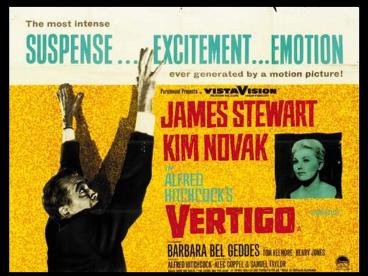
Vertigo A Study of Obsession, Manipulation,
and Power
By Artemus Ward Department of Political
Science Northern Illinois University
3
Cinema 101
- Vertigo is a master class in film technique.
- For example, the first half of the film
alternates scenes that are silent vs. those that
involve dialogue. The silent scenes are composed
primarily of subjective point-of-view (POV)
shots, while the dialogue scenes tend to isolate
the participants in separate shots. - The first half of the film is largely from
Scotties POV. Beginning with Judys flashback,
her POV is used to shift our focus from Scottie
to her. - Scottie's mental breakdown, caused by "acute
melancholy combined with a guilt complex," as
well as his continuing love for Madeleine, serves
a plot function in allowing a year to pass before
the story resumes with the appearance of Judy. - The "Vertigo shot" was created by simultaneously
zooming in and tracking backward the result is
that the foreground remains stable while the
background expands backwards. The shot was done
using a model of the tower stairs laid
horizontally on its side. The Vertigo shot has
been widely imitated, including in Jaws,
Goodfellas, and the first Lord of the Rings
movie. - Hitch pays careful attention to colors throughout
the film including Madeleine/Judys primary color
(green) and Scotties (red) swapping them and
changing colors to suit the narrative when needed.
4
Storyboarding
5
Vertigos Mythology IOrpheus and Eurydice
- Vertigo is based on a series of ancient Greek and
Roman myths. - Perhaps the most obvious mythological influence
on the film is the Greek myth of Orpheus and
Eurydice, in which the musician Orpheus loses his
wife, Eurydice, to death and ventures into the
underworld to rescue her, only to lose her again.
Vertigo plays off of two central themes of this
story. First, Scottie's Orpheus character
attempts to save Madeleine, the Eurydice
character, from drowning in the San Francisco
Bay. He succeeds, only to lose her in a suicide
off the bell tower. - He then gets a second chance to save Madeleine
from death, this time by recreating Judy in
Madeleine's image. He achieves this resurrection,
but then loses her again when she plunges from
the bell tower. And just as in the Orpheus myth
it is Orpheus's faulthis failure to follow the
instruction not to look back at his beloved as he
leads her out of Hadesthat he loses Eurydice
again, so in Vertigo it is Scottie's flaws that
lead to his losses his acrophobia causes him to
lose Madeleine and it is his insistence on
recreating a dead woman that leads him to lose
Judy.
6
Vertigos Mythology II Pygmalion and Galatea
- The Roman myth of Pygmalion and Galatea is also a
clear influence on Vertigo. The sculptor
Pygmalion (Scottie in the film) uses his art to
create a sculpture of the perfect woman
(Vertigo's Madeleine) and then tragically falls
in love with his creation. - George Bernard Shaw's play Pygmalion, which was
later adapted into the musical My Fair Lady
(1964), also echoes here, particularly in the
scenes in which Scottie, as a Pygmalion Professor
Higgins, attempts to transform Judy, his Eliza
Doolittle, into a proper lady, but without any of
the comic effects of the play. - Other film representations of Pygmalion occur in
John Landis Trading Places (1983) John Hughes
Weird Science (1987) Woody Allens Mighty
Aphrodite (1995) the Freddie Prince, Jr. vehicle
Shes All That (1999) and Lars and the Real Girl
(2007).
7
Vertigos Mythology III Tristan and Isolde
- Scottie can also be seen as Tristan, the
ill-fated lover of the medieval legend Tristan
and Isolde, who marries a second woman named
Isolde when the true Isolde of his passions weds
another. That legend ends with the death of
Tristan and the suicide of his beloved, just as
Vertigo ends with Judy/Madeleine's accidental
death and Scottie's living death in the wake of
tragedy. - A film version of Tristan and Isolde was released
in 2006 with James Franco in the lead role.
8
Manipulation
- This is a film about obsession and control by
manipulation and fabrication of reality - Scottie (Stewart) is manipulated by his friend
Gavin, who also manipulates the woman (Kim Novak,
brilliant in a dual role) who in turn manipulates
Scottie. - Indeed, three times in the film Scottie attempts
to leave a room to escape the manipulation but
each time he returns only to get more deeply
involved in the plot In Midges apartment just
before he tries to lick his acrophobia, in
Elsters office when he tries to get out of the
job, and finally in Judys apartment when he asks
her to dinner. - When the deception is complete and Scottie
believes that the woman he loves has died, he is
lost until he sees a girl who resembles her. (She
is her, but not her, at the same time.) He then
does to her what had been done to him he
manipulates her, denies her her own identity and
makes her over until she is the simulacrum of a
woman who never was. When he discovers how he had
been fooled by a theatrical illusion, he hisses,
Did he train you? Did he rehearse you? Did he
tell you what to do and what to say?
apparently not realizing that he is furious and
indignant about the very behavior he has been
exhibiting. - Hitch uses mirrors and mirror images to reinforce
the idea of manipulation and confusion over what
is real and what is not. - Madeleine It's as though I were walking down a
long corridor that once was mirrored, and
fragments of that mirror still hang there. . .
.Scottie The small scenes, the fragments of the
mirror. . . . Do you remember those?
9
The Image of a Woman I
- On one level the film is about men
manipulating/shaping the image of a woman. - Many have argued that Hitchcock was portraying
his own failed attempts to re-create Grace Kelly
in other actresses. - Kelly was Hitchcocks favorite actress and the
two worked together in three successive films
Dial M for Murder (1954), Rear Window (1954), and
To Catch a Thief (1955). He made her a star. - But Kelly married Prince Rainier of Monaco and by
becoming Princess Grace, she gave up her career.
For the rest of her life, she was to remain in
the news with her marriage and her three
children. She missed Hollywood and even planned
to return to make Marnie for Hitchcock. But the
people of Monaco were incensed and she withdrew.
On September 14, 1982, she was killed in an
automobile accident, on a cliff road she had
known so well since her first visit to the
Riviera. The spot is said to be the same spot
where the picnic scene from To Catch a Thief
(1955) was filmed in 1954. She was just 52 years
old.
10
The Image of a Woman II
- In the years that followed, Hitchcocks leading
ladies were all cool, platinum blondes in the
mold of Kelly including Vera Miles in The Wrong
Man (1956) and Psycho (1960), Doris Day in The
Man Who Knew Too Much (1956), Kim Novak in
Vertigo (1958), Eve Marie Saint in North by
Northwest (1959), Janet Leigh in Psycho (1960),
and Tippi Hedren in The Birds (1963) and Marnie
(1964).
11
James Stewart as Scottie
- Hitchcock was one of the few filmmakers who
recognized that Stewart had a complex, even dark
side and wanted to explore that in Vertigo. - Morality, decency, kindness, intelligence,
wisdomall the qualities that we think heroes are
supposed to possess and that we have seen Stewart
exhibit in film after filmdesert him little by
little in Vertigo until he has nothing left. - Stewart once said I look for a manwhose
judgment is not always too good and who makes
mistakes. I think human frailty is a very nice
thing to portray.
12
Kim Novak as Madeleine and Judy
- Novak commented on her role When I read the
lines, I want you to love me for me, I just
identified with it so much. It was what I felt
when I came to Hollywood as a young girl. You
know, they want to make you over completely. They
do your hair and makeup and it was always like I
was fighting to show some of my real self. So I
related to the resentment of being made over and
to the need for approval and the desire to be
loved. I really identified with the story because
it was me saying, Please, see who I am. Fall in
love with me, not a fantasy. - Hitch deftly softens the sobering abuse of his
female protagonist, Madeleine/Judy, by focusing
on the passion and torment of her lover, Scottie
(and by casting the likeable Stewart). - Consider the scenario, though, from Judys
perspective - Shes picked up by one significantly older man,
Elster, who gives her a new persona (Madeleine)
and then involves her in the original Madeleines
murder. - Elster promises her a deeper attachment, only to
dump her unceremoniously after the deed is done. - Then Judy finds the process repeated with
Scottieyet, despite his earnestness, his
behavior is doubly humiliating, as it carries an
implicit rejection of Judys own self in favor of
the fantasy of Madeleine. - Judy, like so many of us, is so desperate for
approval and love that she allows all of this to
happen, ultimately leading to her death.
13
Barbara Bel Geddes as Midge
- As he does in so many of his films. Hitchcock
casts a strong, domineering motherly figure for
the leading man. In this case, his former fiancé
and best friend Midge. - Midge reinforces Scotties helplessness. He has
been overwhelmed by the events of the past and
looks to a female figure to comfort him. During
his first attempt to cure himself of acrophobia,
he collapses on Midges shoulder in a position
that suggests maternal comfort. - Midge is grounded in practical reality from her
practical job designing underwear to her
skepticism of Madeleine. - She takes charge of his care at the hospital
after Madeleines death just as a mother
should. - Though she is Madeleine/Judys rival for
Scotties affections, she has no scenes with
Madeleine/Judy.
14
Voyeurism
- One of Hitchcocks major themesparticularly in
his 1950s worksis voyeurism. - The film Rear Window, which also stars Stewart,
is the master study of the subject. - Yet Vertigo can be seen as a long romantic poem
to voyeurism that leads the viewer through
lengthy specific sequences of silent pursuit, and
through a much darker and broader story of one
mans pursuitto unthinkable extremesof his
chosen romantic ideal. Scottie watches Madeleine
and we watch Scottie watch Madeleine. - Indeed one way Hitch establishes his voyeurism
theme is through the use of eyes and swirlsfrom
the opening sequence, to Madeleines hairstyle,
to the expressive eyes of the main characters
15
The Wrong Man Or Woman
- Perhaps Hitchcocks most famous recurring theme
in many of his films is the innocent wrongly
pursued. And it is not the pursuer whom the
pursued has to fear as much as the circumstances
into which he or she must run to escape. - Though not one of his classic wrong man films,
Vertigo is still a variation on this theme. In
Vertigo, Hitchcock chose a woman as the party to
be pursued and, eventually degraded.
16
Law Power and Freedom I
- How is the law portrayed in the film? Through the
lens of power and freedom - Midge says to Scottie You were the bright,
young lawyer who decided... ...he was going to be
chief of police someday. What does this tell us
about Scottie? He is a do-gooder who sacrifices
wealth and a life of comfort (power and freedom)
for the gritty reality of police work such as
chasing suspects across rooftops. He wants to
change things from the ground up rather than from
the top down. - Elster dominates Scottie and uses Scotties
do-gooder mentality, obsessive personality, and
vertigo to commit the perfect crime murdering
his wife for money and getting away with it. He
says "The things that spell San Francisco to me
are disappearing fast. . . . I should have liked
to live here then. Color, excitement, power,
freedom. . . . - Pop Liebel "The beautiful Carlotta, the sad
Carlotta. . . . A rich man, a powerful man. It is
not an unusual story. He took her. . . . Then he
threw her away. . . . You know, men could do that
in those days. They had the power and the
freedom." - At the end of the film Scottie says "I need you
to be Madeleine for a while, then when it's over
we'll both be free. And then what did he do? Did
he train you? Did he rehearse you? Did he tell
you exactly what to do, what to say? You were a
very apt pupil too, weren't you? You were a very
apt pupil. . . . He made you over, didn't he? He
made you over just like I made you over, only
better. . . . Not only the clothes and the hair,
but the looks and the manner and the words. . . .
Oh Judy, with all of his wife's money and all
that freedom and power, he ditched you.
17
Law Power and Freedom II
- In most cases, an inquest is judicial
investigation by a group of court-appointed
people (a jury) into a cause of death. How is the
coroners inquest into Madeleines death
portrayed? - The coroner knows it is a routine proceeding and
a formality because Scottie is a former Detective
and will be cleared by his friends in the
prosecutors office. Hence the coroner resents
that he powerless and his skeptical, cynical tone
imparts blame on Scottie, who is also powerless
It is a pity that, knowing her suicidal
tendencies... ...he did not make a greater
effort. But we are not here to pass judgment on
Mr. Ferguson's lack of initiative. He did
nothing... ...and the law has little to say on
the subject of things left undone. Nor does his
strange behavior after he saw the body fall...
...have any bearing on your verdict. He did not
remain at the scene of the death. He left. He
claims he suffered a mental blackout and knew
nothing more... ...until he found himself back in
his own apartment in San Francisco hours later.
You may accept that, or not. - The jury of course finds that Madeleine committed
suicide by reason of insanity just as Elster
had planned. They also clear Elster of
responsibility for not reporting his wife's
mental instability. - The scene demonstrates how the law is about power
and manipulation as both the coroner and Scottie
are dominated by more powerful adversaries. - The scene also parallels the opening scene where
the police officer stops his pursuit of the
accused in order to go back to help his
colleague. The result is that the accused gets
away, the officer dies, and the detective has to
quit the force because of vertigo. The inquest
similarly shows that when the judicial process
protects its own by exonerating Scottie the
real criminal goes free and Scottie is further
damaged.
18
Is It All a Dream?
- How does Scottie get down from his dangling
position at the start of the story? One critical
theory is that he doesn't, that the entire movie
is a hallucination, an oneiric narrative. Vertigo
ends as it begins, with Scottie staring down
helplessly from a great height--though with his
vertigo cured.
19
Deleted Scene
- Hitchcock shot an additional scene following the
climax at the tower. In a single shot lasting 75
seconds with no dialog, it shows Scottie
returning to Midge's apartment, where she is
listening to a radio report about the impending
arrest of Gavin Elster in Europe. This scene
apparently was intended as insurance against
objections from the Production Code either in the
U.S. or in other countries. It may have been
shown in some places, but was not part of
Hitchcock's final cut of Vertigo. - Does it make a difference whether Elster was
caught or not?
20
Conclusion
- Hitchcock wants us to consider how desire for
power and freedom can lead to obsession,
manipulation, and ultimately immoral and illegal
behavior. - Like everything in life, both law and morality
are subject to manipulation, thereby blurring the
line between what is real and what is unreal.
21
Credits
- Auiler, Dan. 1998. Vertigo The Making of a
Hitchcock Classic. New York, NY St.Martins
Griffin. - Dirks, Tim. Undated. Vertigo (1958).
Filmsite.org. http//www.filmsite.org/vert.html - Spotto, Donald. 1992. The Art of Alfred
Hitchcock, 2nd ed. New York, NY Doubleday.
Recommended

