

Most common types of titrations : PowerPoint PPT Presentation
1 / 33
Title: Most common types of titrations :
1
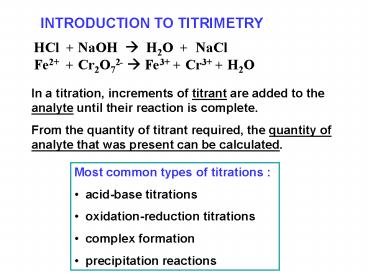
INTRODUCTION TO TITRIMETRY
HCl NaOH ? H2O NaCl Fe2 Cr2O72- ?
Fe3 Cr3 H2O
In a titration, increments of titrant are added
to the analyte until their reaction is complete.
From the quantity of titrant required, the
quantity of analyte that was present can be
calculated.
- Most common types of titrations
- acid-base titrations
- oxidation-reduction titrations
- complex formation
- precipitation reactions
2
TITRATIONS IN PRACTICE
Accurately add of specific volume of sample
solution to a conical flask using a pipette
Known volume/mass of sample
Unknown concentration of analyte in sample
3
Slowly add standard solution from a burette to
the sample solution
Known concentration of the titrant
4
Add until just enough titrant is added to react
with all the analyte
The end point is signaled by some physical change
or detected by an instrument
Note the volume of titrant used
Known volume of the titrant
5
FINDING END POINTS WITH A pH ELECTRODE
After each small addition of titrant the pH is
recorded and a titration curve is plotted.
- 2 ways of determining end points from this
- using derivatives
- using a Gran plot
6
If we have HA BOH ? BA H2O
analyte
titrant
Then from the balanced equation we know 1 mol
HA reacts with 1 mol BOH
We also know CBOH, VBOH and VHA or Masssample
and
?
7
STANDARD SOLUTIONS
Standard solution Reagent of known concentration
Primary standard highly purified compound that
serves as a reference material in a titration.
Determine concentration by dissolving an
accurately weighed amount in a suitable solvent
of known volume.
Secondary standard compound that does not have a
high purity
Determine concentration by standardisation.
Titrate standard using another standard.
Standard solutions should
- Be stable
- React rapidly with the analyte
- React completely with the analyte
- React selectively with the analyte
8
Indicators used to observe the end point at/near
the equivalence point)
Thymol blue indicator
Instruments can also be used to detect end
points. Respond to certain properties of the
solution that change in a characteristic way.
E.g. voltmeters, ammeters, ohmmeters,
colorimeters, temperature recorders,
refractometers etc.
9
EQUIVALENCE POINT
END POINT
VS
An estimate of the equivalence point that is
observed by some physical change associated with
conditions of the equivalence point.
The amount of added titrant is the exact amount
necessary for stoichiometric reaction with the
analyte in the sample.
Aim to get the difference between the equivalence
point and the end point as small as possible.
Titration error Et Veq Vep
Estimated with a blank titration
10
Measured Titration Curve
11
Titration Curve Plot of pH vs Volume
Titrant
12
End Point and Indicator pKa
- For Phenol Red (a weak acid!)
- HIn ? H In- pKIn
7.9 - color yellow red
- acid
base - KIN H In-/HIn
H-H equation pH pKIN log In-/HIn
Human eye can detect color difference when ratio
of colored forms is about 101 In-/HIn
10/1 to 1/10 log ? 1 to
-1
So, pHstoichiometric point pKin 1
13
Colors and Approximate pH Range of Some Common
Acid-Base Indicators
14
(No Transcript)
15
(No Transcript)
16
ACID BASE TITRATIONS
We will construct graphs to see how pH changes as
titrant is added.
- Start by
- writing chemical reaction between titrant and
analyte - using the reaction to calculate the composition
and pH after each addition of titrant
17
TITRATION OF STRONG BASE WITH STRONG ACID
ExampleTitrate 50.00 ml of 0.02000 M KOH with
0.1000 M HBr.
HBr KOH ? KBr H2O
What is of interest to us in an acid-base
titration H OH- ? H2O
Mix strong acid and strong base ? reaction
goes to completion
Calculate volume of HBr needed to reach the
equivalence point, Veq
But n1 n2 1
? CHBrVeq CKOHVKOH
(0.1000 M)Veq (0.02000 M)(50.00 ml)
Veq 10.00 ml
18
There are 3 parts to the titration curve
- Before reaching the equivalence point
- ? excess OH- present
- At the equivalence point
- ? H OH-
- After reaching the equivalence point
- ? excess H present
19
- Before reaching the equivalence point ? excess
OH- present
Say 2.00 ml HBr has been added.
Starting nOH- (0.02 M)(0.050 L) 1x10⁻³
mol
COH- 0.01538 M
nH added (0.1 M)(0.002 L) 2x10⁻⁴ mol
Vtotal 50 2 mL 52 mL 0.052 L
- nOH- reacted
- 8x10⁻⁴ mol
Kw HOH- 1x10-14 H(0.01538 M)
H 6.500x10⁻¹³ M
Report pH to 2 decimal places ? near to limit of
accuracy in pH measurement
20
- At the equivalence point ? nH nOH-
pH is determined by dissociation of H2O H2O ?
H OH-
x
x
Kw HOH- 1x10-14 x2 x
1x10-7 M ? H 1x10⁻⁷ M
? pH 7
pH 7 at the equivalence point ONLY for strong
acid strong base titrations!!
21
- After reaching the equivalence point? excess H
present
Say 10.10 ml HBr has been added.
Starting nOH- 1x10⁻³ mol
CH 1.664x10⁻⁴ M
nH added (0.1 M)(0.0101 L) 1.010x10⁻³ mol
pH 3.78
- nH excess
- 1x10⁻⁵ mol
Vtotal 50 10.1 mL 60.1 mL
0.0601 L
22
Note A rapid change in pH near the equivalence
point occurs.
Equivalence point where
- slope is greatest
23
TITRATION OF WEAK ACID WITH STRONG BASE
Example Titrate 50.00 ml of 0.02000 M formic
acid with 0.1000 M NaOH.
HCO2H NaOH ? HCO2Na H2O
OR HCO2H OH- ? HCO2- H2O
HA
A-
pKa 3.745
Equilibrium constant so large ? reaction goes
to completion after each addition of OH-
Ka 1.80x10⁻⁴ Kb 5.56x10⁻¹¹
Strong and weak react completely
24
Example Titrate 50.00 ml of 0.02000 M formic
acid with 0.1000 M NaOH.
Calculate volume of NaOH needed to reach the
equivalence point, Veq
But n1 n2 1
? CNaOHVeq CFAVFA
(0.1000 M)Veq (0.02000 M)(50.00 ml)
Veq 10.00 ml
25
There are 4 parts to the titration curve
- From first addition of NaOH to immediately before
equivalence point ? mixture of unreacted HA and
A- - HA OH- ? A- H2O
- BUFFER!! ? use Henderson-Hasselbalch eqn for pH
26
4) Beyond the equivalence point ? excess OH-
added to A-. Good approx pH
determined by strong base (neglect small effect
from A-)
27
- Before base is added
- ? HA and H2O present. HA weak acid.
x2 1.80x10-4x 3.60x10-6 0
x 1.81x10-3
? H 1.81x10⁻³
? pH 2.47
28
- From first addition of NaOH to immediately before
equivalence point ? mixture of unreacted HA and
A- . BUFFER!!
Say 2.00 ml NaOH has been added.
Starting nHA (0.02 M)(0.05 L) 1x10⁻³ mol
nOH- added (0.1 M)(0.002 L) 2x10⁻⁴ mol
HA OH- ? A- H2O
? pH 3.14
29
But VA VHA VTot
Special condition
When volume of titrant ½ Veq pH pKa
Since
nHA nA-
30
- At the equivalence point
- ? all HA converted to A-. A- weak base.
(nHA nNaOH)
Starting nHA 1x10⁻³ mol
HA OH- ? A- H2O
? nOH- 1x10⁻³ mol
- Solution contains just A- ? a solution of weak
base
31
Kb 5.56x10⁻¹¹
A- H2O ? HA OH-
F- x
x
x
Vtotal 50 10 mL 60 mL 0.060 L
0.0167 M
OH- 9.63x10-7 M
x2 5.56x10-11x 9.27x10-13 0
pOH 6.02
x 9.63x10-7
pH 7.98
pH is slightly basic (pH above 7) for strong
base-weak acid titrations
32
CALCULATED TITRATION CURVE
33
TITRATION CURVE OF WEAK BASE WITH STRONG ACID
34
Calculating the pH During a Weak Acid-Strong Base
TitrationI
Problem Calculate the pH during the titration of
20.00 mL of 0.250 M nitrous acid (HNO2 Ka 4.5
x 10-4) after adding different volumes of 0.150 M
NaOH (a) 0.00 mL (b) 15.00 mL (c) 20.00 mL (d)
35.00 mL. Plan (a) We just calculate the pH of a
weak acid. (b)-(d) We calculate the amounts of
acid remaining after the reaction with the base,
and the anion concentration, and plug these into
the Henderson-Hasselbalch eq. Solution
HNO2 (aq) NaOH(aq)
H2O(l) NaNO2 (aq)
(a)
H3O NO2-
x (x)
Ka
4.5 x 10-4
x2 1.125 x 10-4 x 1.061 x 10-2
HNO2
0.250 M
pH -log(1.061 x 10⁻²) 2.000 - 0.0257 1.97
no base added
35
Calculating the pH During a Weak Acid-Strong Base
TitrationII
(b) 15.00 mL of 0.150 M NaOH is added to the
20.00 mL of 0.250 M HNO2 (20.00 mL x 0.250
mmol/mL 5.00 mmol HNO2) which will neutralize
(15.00 mL x 0.150 mmol/mL 2.25 mmol of HNO2),
leaving 2.75 mmol HNO2, and generating 2.25 mmol
of nitrite anion.
Concentration (M)
Initial 0.00275 ----
0
0.00225 Change -x
---- x
x Equilibrium 0.00275 - x ----
x 0.00225 x
pH 3.35 -0.0872 3.26 with 15.0 mL of NaOH
added
36
Calculating the pH During a Weak Acid-Strong Base
TitrationIII
(c) 20.00 mL of 0.150 M NaOH is added to the
20.00 mL of 0.250 M HNO2 (20.00 mL x 0.250
mmol/mL 5.00 mmol HNO2) which will neutralize
(20.00 mL x 0.150 mmol/mL 3.00 mmol of HNO2),
leaving 2.00 mmol HNO2, and generating 3.00 mmol
of nitrite anion.
Concentration (M)
Initial 0.00200
---- x 0.00300
pH 3.35 0.176 3.53 with 20.00 mL of base
added
37
Calculating the pH During a Weak Acid-Strong Base
TitrationIII
(d) 35.00 mL of 0.150 M NaOH is added to the
20.00 mL of 0.250 M HNO2 (20.00 mL x 0.250
mmol/mL 5.00 mmol HNO2) which will neutralize
(35.00 mL x 0.150 mmol/mL 5.25 mmol of HNO2),
leaving no HNO2, and generating 5.00 mmol of
nitrite anion. There will be an excess of 0.25
mmol of NaOH which will control the pH.
38
Calculating the pH During a Weak Acid-Strong Base
TitrationIV
(d) continued Since all of the HNO2 has
been neutralized, we only have to look at the
concentration of hydroxide ion in the total
volume of the solution to calculate the pH of
the resultant solution.
combined volume 20.00 mL 35.00 mL 55.00 mL
0.000250 mol OH-
OH- 0.004545
M
0.05500 L
Kw
1 x 10-14
H3O
2.200 x 10⁻¹²
OH-
0.004545
pH -log (2.200 x 10⁻¹²) 12.000 - 0.342
11.66 when all of the acid
neutralized, and there
is an excess of NaOH
Recommended

