

Intraocular Lens Implantation as a Secondary Procedure in Neonatal Cataract PowerPoint PPT Presentation
1 / 10
Title: Intraocular Lens Implantation as a Secondary Procedure in Neonatal Cataract
1
Intraocular Lens Implantation as a Secondary
Procedure in Neonatal Cataract
We have no financial interest in this presentation
- Dr. Ashok P. Shroff, MD
- Dr. Hardik A. Shroff, MD
- Dr. Dishita H. Shroff. MD
- Shroff Eye Hospital
- Navsari India.
- Email sehnavsari_at_yahoo.co.in
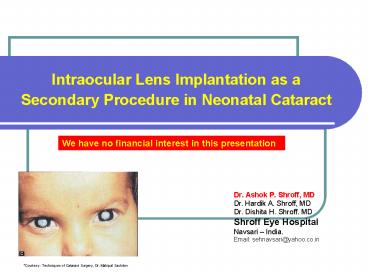
Courtesy Techniques of Cataract Surgery, Dr.
Mahipal Sachdev
2
Introduction
- Management of cataract is surgical but when the
patient is infant then it requires special
consideration because anatomy of infants eye is
very much different from adults. Moreover their
growth is also very fast in first two years of
life. (Ref. 1 2)
- AP length
- At birth 16.8 mm
- First two years 22 mm
- At 16 years 23 mm
- Adult 23.6 mm
- Corneal curvature
- At birth 47 to 51 D
- Lens
- Horizontal diameter
- Infant 6 mm
- 21 months 8.4 mm
- 16 years 9.3 mm
- Lens capsule elastic, on puncture ? radially
oriented tears
- Sclera very elastic
- Vitreous more viscous and formed
- Visual system
- Up to 8 years development continues
Therefore while considering surgery in
paediatric cataract, consider following points
- Age of the child
- Time of surgery
- Laterality
- Anaesthesia
- IOL (Newer designs ref. 3)
- Power calculation
- Type of IOL
- Possible complications
3
Purpose
- With the advent of newer technique and designs of
IOLs, primary IOL implantation at / after 2 years
is safe and gives excellent results. - But if the child is under one year then all the
surgeons do not agree for primary implantation.
Hence we have done it in two stages. - In this series, we have tried to evaluate
secondary IOL implantation in neonates / infants
with reference to long term results.
4
Demography
- No of patients 6
- No of eyes 12
- Previous surgical history
- Cataract removal by bimanual technique with
primary posterior capsulotomy by vitreous cutter - Time lapsed between previous surgery and present
procedure 10 to 14 months
5
Method
- All the children were examined under GA for
- Anterior segment
- Peripheral capsular support
- IOPr
- Posterior segment evaluation
- Keratometry
- A-scan biometry
6
Method (Contd.)
- Procedure
- Lids were separated by using appropriate speculum
- Corneoscleral tunnel was made in upper part of
limbus at convenient area - Two stab incisions at limbus were made at 10 and
2 oclock position - Anterior chamber was entered with triangular
pointed knife - AC was filled with viscoelastic
7
Method (Contd.)
- Adhesion between iris and capsule was gently
separated using iris repositor from both stab
wounds - Corneoscleral wound was enlarged up to 6 mm in
width - Appropriate PMMA IOL was introduced and was
gently dialed to place in the sulcus - Visco was removed using bimanual irrigation
aspiration - Anterior chamber was formed with air / BSS
- Conjunctiva was closed with wet field cautery
8
Results
- IOL was well placed in sulcus in all the cases
- Pupillary area remained clear in all cases
- Retina was found to be ok till last examination (
even after 2 years) - All the children behave well visually as their
routine activities found to be normal by their
parents
9
Discussion
- As mentioned earlier, congenital cataracts in
both eyes need immediate surgical intervention at
any age. - Primary posterior capsulotomy by vitrectomy
cutter is MUST to have clear visual axis - Though many surgeons do primary IOL implantation
(Ref. 4), we have resorted to do it at a later
date for obvious reasons mentioned earlier - Till then visual rehabilitation may be maintained
by glasses or contact lenses (Status of clear
visual axis is better even without correction is
much better than obscured by cataract). - IOL implantation at about 2 years age would be
more appropriate because of proper anatomical
growth. - Due to opening in posterior capsule and adhesions
of capsular bag, IOL implantation may but be easy
in the bag. - However, good quality and appropriate size of IOL
can be placed in the sulcus after removing the
adhesion between iris and capsular bag. - As manipulation is minimum and vitreous
disturbance is almost nil, retina remained ok
even after 2 years
10
Conclusion
- 12 eyes of 6 children between 5 to 11 months were
operated previously for cataract with posterior
capsulotomy by vitreous cutter - At appropriate age (i.e. between 1.5 to 2 years)
they were taken up for secondary IOL implantation - IOL power was calculated using Vasavada formula
- IOL implantation in the sulcus was easy after
separating the adhesion between iris and capsules - Visual outcome was good.
- References
- Gardan RA, Danzis PB Refractive development of
the human eye Archives of ophthalmology,
1985103785-789 - Inagaki Y The rapid change of corneal curvature
in the neonatal period and infancy Archives of
ophthalmology, 19861041026-1027 - Suresh k pandey M Edward Wilson at al
Paediatric cataract surgery and IOL implantation
Techniques of cataract surgery2007371-377 - Vasavada A, Chouhan H Intraocular lens
implantation in infants with congenital
cataracts journal of cataract and refractive
surgery194420592-7
Recommended

