

Project : Phase 1 Grading PowerPoint PPT Presentation
1 / 19
Title: Project : Phase 1 Grading
1
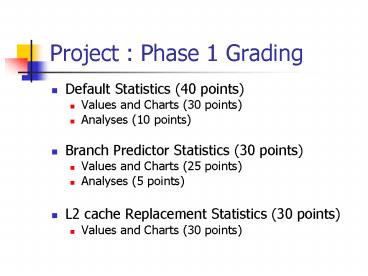
Project Phase 1 Grading
- Default Statistics (40 points)
- Values and Charts (30 points)
- Analyses (10 points)
- Branch Predictor Statistics (30 points)
- Values and Charts (25 points)
- Analyses (5 points)
- L2 cache Replacement Statistics (30 points)
- Values and Charts (30 points)
2
Default Statistics Analyses
- CPI affected by
- Percentage of branches, predictability of
branches - Cache hit rates
- Parallelism inherent in programs
- CPI of cc and go higher than others
- Larger percentage of tough to predict branches
- cc 17 branches abt 12 of which is
miss-predicted - Go 13 branches abt 20 of which is
miss-predicted - CPI of cc higher than go
- L1 miss rate of cc (2.6) is higher than go (0.6)
3
Default Statistics Analyses
- Compress has high miss rates
- Smaller execution run compulsory misses
- L2 miss rate of anagram high
- Very few L2 accesses compulsory misses
- Program based analyses
- Gcc has lot of branches
- Go program has small memory footprint
- Anagram is a simple program
- Compress input file only 20 bytes
- Note All are integer programs
- CPI lt 1, multiple issue, out of order
4
Branch Predictor Statistics
- Perfect gt Bimodal gt taken not-taken
- Variation across benchmarks (2 points)
- Go and cc show greatest variation
- They have significant number of tough to predict
branches.
5
L2 replacement policies
- No great change in miss-rate or CPI
- 30 points for the values and plots
- L1 cache was big so very few L2 accesses
- Associativity of L2 cache was small
- LRU gt FIFO gt Random
6
Distribution
- 90 100
7
Phase 2 Profile guided OPT
- Profiling Run
- Run un-optimized code with sample inputs
- Instrument code to collect information about the
run - Callgraph frequencies
- Basicblock frequencies
- Recompile
- Use collected information to produce better code
- Inlining
- Put hot code together to improve I
8
Phase 2 Compiler branch hints
- if (error) // not-taken
- Compiler provides hints about branches
taken/not-taken using profile information - In this question
- Learn to use simulator as a profiler
- Learn to estimate benefits of optimizations.
9
Example
- Simple loop
- 1000
- 1004
- // mostly not taken
- 1008 jz 1020
- 1012 jmp 1000
- For each branch mark taken or not-taken
- Taken gt 50
- Mark taken
- Not-taken gt 50
- Mark Not-taken
- In the above example
- 1008 not-taken
- 1032 not-taken
- 1064 taken
10
Profiling Run
- For each static branch instruction
- Collect execution frequency
- Percentage taken/not-taken
- Modify bpred_update function in bpred.c
- Maintain data structure for each branch
instruction indexed by instruction address - Maintain frequency, taken information
- Dump this information in the end.
11
Analysis
- From the information collected
- If branch is taken gt 50 of time, mark taken
- Otherwise not-taken
- Remember the instruction addresses and the hint.
12
Performance Estimation
- For all branches
- Predict taken/ not-taken according to the hint
- You may want to load all the hints into a data
structure at the start. - Data structure similar to one used for profiling.
- Indexed by branch instruction address.
- Estimate new CPI
- Notes
- Sufficient to do this for cc and anagram.
- After modifying SimpleScalar need to make !!!
13
Phase2 L2 replacement policy
- LRU policy
- Works well
- HW complexity is high
- Number of status bits to track when each block in
a set is last accessed - This number increases with associativity.
- PLRU
- Pseudo LRU policies
- Simpler replacement policy that attempts to mimic
LRU.
14
Tree based PLRU policy
- For a n way cache, there are nway -1 binary
decision bits - Let us consider a 4 way set associative cache
- L0, L1, L2 and L3 are the blocks in the set
- B0, B1 and B2 are decision bits
15
Tree based LRU for 4 way
16
Notes
- Use a 4K direct mapped L1 cache
- Hopefully this should lead to L2 accesses!
- Use a 16 way 256 KB L2 cache
- Hopefully enough ways to make a difference!
- Compare PLRU with LRU, FIFO and Random
- Sufficient to do this experiment for cc and
anagram!
17
Perfect Mem Disambiguation
- Memory Disambiguation
- Techniques employed by processor to execute
loads/stores out of order - Use a HW structure called Load/Store queue
- Tracks addresses / values of loads and stores
- Load can be issued from LSQ
- If there are no prior stores writing to the same
address. - If address in unknown, then cant issue load
- Perfect Disambiguation
- All addresses are known
18
How are addresses known
- Two ways to do this
- Trace based Run once and collect and remember
all the addresses - All registers values are actually known to the
simulator through functional simulation - Even though a register is yet to be computed,
the simulator knows the value - Look at lsq_refresh() function in sim-outorder.c
- To give you flexibility to do both ways
- Simulate only a million instructions
- Fast forward 100 million instructions
19
Mem Disambiguation
- Compare CPI with and without perfect
disambiguation - Sufficient to do this for cc and go
- -fastfwd 100 million instructions
- Simulate for additional 1 million instructions
Recommended

