

The Four Color Theorem (4CT) PowerPoint PPT Presentation
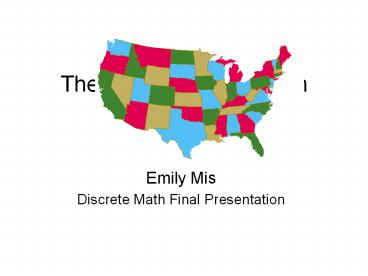
Title: The Four Color Theorem (4CT)
1
The Four Color Theorem(4CT)
- Emily Mis
- Discrete Math Final Presentation
2
Origin of the 4CT
- First introduced by Francis Guthrie in the early
1850s - Communicated to Augustus De Morgan in 1852
- First printed reference of the theorem in 1878 in
the Proceedings of the London Mathematical
Society - The original problem was stated to be
- the greatest number of colors to be used in
coloring a map so as to avoid identity of color
in lineally contiguous districts is four. - -Frederick Guthrie to the
Royal Society of Edinburgh (1880)
3
Graph Theory for the Four Color Conjecture
4
Graph Theory for the Four Color Conjecture
5
Graph Theory for the Four Color Conjecture
6
Any Planar Map Is Four-Colorable
- Planar graph - a graph drawn in a plane without
any of its edges crossing or intersecting - Each vertex (A,B,C,D,E) represents a region in a
graph - Each edge represents regions that share a boundary
In any plane graph each vertex can be assigned
exactly one of four colors so that adjacent
vertices have different colors. -Four-Color
Conjecture
7
Proving the Conjecture
- A. B. Kempe in 1879
- Found to be flawed by Heawood in 1890
- Introduced a new technique now called Kempes
chains
8
Kempes Chains
A four-sided region R is surrounded by Regions 1
- 4 that have already been colored by the four
available colors
9
Kempes Chains
A four-sided region R is surrounded by Regions 1
- 4 that have already been colored by the four
available colors
First consider all regions colored b and
d. Either there is a chain of regions colored b
and d connecting Region 2 and Region 4, or no
such chain exists. If no chain exists, you can
change the color of either Region 4 or Region 2
in order to free up the other color for the
center region R.
10
Proving the Conjecture
- A. B. Kempe in 1879
- Found to be flawed by Heawood in 1890
- Introduced a new technique now called Kempes
chains
- P. G. Tait in 1880
- Found to be flawed by Peterson in 1891
- Found an equivalent formulation of the 4CT in
terms of three-edge coloring
No two edges coming from the same vertex share
the same color
11
Proving the Conjecture
- A. B. Kempe in 1879
- Found to be flawed by Heawood in 1890
- Introduced a new technique now called Kempes
chains - 1900s brought proofs on limited sets of regions
- Increased to a 90-region proof in 1976 by Mayer
- P. G. Tait in 1880
- Found to be flawed by Peterson in 1891
- Found an equivalent formulation of the 4CT in
terms of three-edge coloring
12
other concerned parties
- Sir William Hamilton
- Arthur Cayley
- Lewis Carroll
"A is to draw a fictitious map divided into
counties. B is to color it (or rather mark the
counties with names of colours) using as few
colours as possible. Two adjacent counties must
have different colours. A's object is to force B
to use as many colours as possible. How many can
he force B to use?"
13
other concerned parties
- Sir William Hamilton
- Arthur Cayley
- Lewis Carroll
"A is to draw a fictitious map divided into
counties. B is to color it (or rather mark the
counties with names of colours) using as few
colours as possible. Two adjacent counties must
have different colours. A's object is to force B
to use as many colours as possible. How many can
he force B to use?"
14
The New Proof of the 4CT
- Completed by Appel and Haken in 1976
- Based on Kempes chains
- Required 1200 hours of computation
- Used mostly to perform reductions and discharges
on planar configurations using Kempes original
idea of chains - Introduced a collection of 1476 reducible
configurations - These configurations are an unavoidable set that
must be tested to show that they are reducible - No member of this set can appear in a minimal
counterexample
15
Discharging - Why do it?
- Discharging -- moving a charge along a circuit
of connected vertices in order to cancel positive
and negative values as much as possible - Sites where a positive value remains are often
part of a reducible configuration - G is the smallest maximal plane graph which
cannot be four-colored - each vertex in G gets a charge (6-deg v)
- from Euler, we know that the sum of all G is 12
- A charge is then moved around the circuit to
change the charges of individual vertices - Discharging is used to show that a certain set S
is an unavoidable set
16
Were not in Kansas anymore
- A new version of the computer-based proof was
produced by Robertson, Sanders, Seymour and
Thomas in 1996 - Used a quadratic algorithm for four-color planar
graphs - Decreased the size of the unavoidable set to 633
- The fears
- Is this a movement towards computer-based proof
for traditional mathematical proofs? - Does this proof qualify as a proof based on the
original definition of a proof?
17
Works Cited
- Thomas, Robin (1998) An Update on the Four-Color
Theorem, Notices of the AMS, 45 7848-859 - Brun, Yuriy The Four Color Theorem, MIT
Undergraduate Journal of Mathematics pp 21-28 - Calude, Andreea (2001)The Journey of the Four
Colour Theorem Through Time, The New Zealand
Mathematics Magazine, 38327-35 - Cayley (1879) On the colouring of maps,
Proceedings of the Royal Geographical Society and
Monthly Record of Geography New Monthly Series,
14259-261 - Robertson et al (1996) A New Proof of the
Four-Colour Theorem, Electronic Research
Announcements of the AMS, 2117-25 - Mitchem, John (1981) On the History and Solution
of the Four-Color Map Problem, The Two-Year
College Mathematics Journal, 122108-116 - Bernhart (1991) Review of Every Planar Map is
Four Colorable by Appel and Haken, American
Mathematical Society, Providence RI, 1989 - May, Kenneth (1965) The Origin of the Four-Color
Conjecture, Isis, 563346-348 - Saaty, Thomas (1967) Remarks on the Four Color
Problem the Kempe Catastrophe, Mathematics
Magazine, 40131-36
Recommended

