

The New BACPR Standards and Core Components PowerPoint PPT Presentation
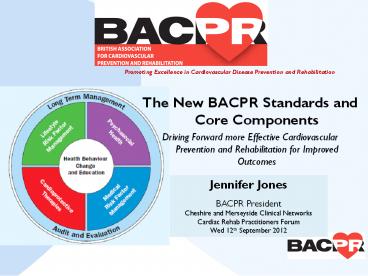
Title: The New BACPR Standards and Core Components
1
Promoting Excellence in Cardiovascular Disease
Prevention and Rehabilitation
- The New BACPR Standards and Core Components
- Driving Forward more Effective Cardiovascular
Prevention and Rehabilitation for Improved
Outcomes
Jennifer Jones BACPR President Cheshire and
Merseyside Clinical Networks Cardiac Rehab
Practitioners Forum Wed 12th
September 2012
2
Aim
- Driving forward more effective cardiovascular
prevention and rehabilitation in light of the new
BACPR Standards and Core Components - 7 core standards and 7 core components are set
out which aim to improve uptake and quality of
rehabilitation programmes nationwide
www.bacpr.com
With special thanks to BHF, BSC, NHS
Improvement, NACR, BANCC, BSH, HCP (UK), UK Heart
Health and Thoracic Dietitians Group, the
original 2007 and 2012 development groups as
well as health care professionals from our
consultation event and BACPR council members past
and present.
3
Overview
- Meet our case
- Background and evidence
- NACR 2011 findings
- Introducing to the 2012 update of the BACPR
Standards and Core Components - Shaping future service delivery
- Promoting excellence in cardiovascular disease
prevention and rehabilitation
4
Case Scenario
- Mr BC is a 51-year-old male from Pakistan
residing in London. Recent anterior STEMI with
primary PCI (drug eluding stent). - He is currently sedentary, has recently quit
smoking and has a family history of premature
atherosclerotic cardiovascular disease (father
died aged 54-years following an acute MI). - Will taking up a cardiovascular prevention and
rehabilitation programme offer benefit?
5
Cardiac Rehabilitation Saves Lives
- There is overwhelming evidence that comprehensive
cardiac rehabilitation is associated with a
reduction in both cardiac mortality (26-36) and
total mortality (13-26). - Heran BS, Chen JMH, Ebrahim S, Moxham T, Oldridge
N, Rees K, Thompson DR, Taylor RS. Exercise-based
cardiac rehabilitation for coronary heart
disease. Cochrane Database of Systematic Reviews
2011, Issue 7. Art. No CD001800. DOI
10.1002/14651858.CD001800.pub2. - Taylor RS, Brown A, Ebrahim S, Jolliffe J,
Noorani H, Rees K, Skidmore B, Stone JA, Thompson
DR, Oldridge N. Exercise-based rehabilitation for
patients with coronary heart disease systematic
review and meta-analysis of randomized controlled
trials. Am J Med 2004 116(10)682-697. - Lawler PR, Filion KB, Eisenberg MJ. Efficacy of
exercise-based cardiac rehabilitation
post-myocardial infarction A systematic review
and meta-analysis of randomized controlled
trials. Am Heart J Oct 2011 162 571-584.
6
Recent
7
Directly Standardised Mortality Rate per 100,000
All Ages - Ischaemic Heart Disease/CHD -
England Three EU Comparators 1993 - 2008
Average Annual Reduction in DSR 1993-2006 5.6
Average Annual Reduction in DSR 1993-2006 3.8
8
Cardiac Rehabilitation Reduces Morbidity
- There is emerging evidence that cardiac
rehabilitation is also associated with a
reduction in morbidity, namely recurrent
myocardial reinfarction - Lawler PR, Filion KB, Eisenberg MJ. Efficacy of
exercise-based cardiac rehabilitation
post-myocardial infarction A systematic review
and meta-analysis of randomized controlled
trials. Am Heart J Oct 2011 162 571-584. - Clark AM, Hartling L, Vandermeer B, McAlister, F.
Meta-Analysis Secondary Prevention Programs for
Patients with Coronary Artery Disease. Ann Intern
Med 2010 143(9) 659-672.
9
British Heart Foundation heart stats 2010
www.bhf.org.uk Smolina et al. 2012 BMJ
2012344doi 10.1136/bmj.d8059(Published 25
January 2012)
CHD Morbidity
CHD Mortality
1940
2010
1970
10
Cardiac Rehabilitation Reduces Hospital
Readmissions
28-56 reduction in costly unplanned
readmissions.
Lam G, Snow R, Shaffer L, La
Londe M, Spencer K, Caulin-Glaser T. The effect
of a comprehensive cardiac rehabilitation program
on 60-day hospital readmissions after an acute
myocardial infarction. J Am Coll Cardiol 2011
57597, doi10.1016/S0735-1097(11)60597-4.
Heran BS, Chen JMH, Ebrahim S, Moxham T, Oldridge
N, Rees K, Thompson DR, Taylor RS. Exercise-based
cardiac rehabilitation for coronary heart
disease. Cochrane Database of Systematic Reviews
2011, Issue 7. Art. No CD001800. DOI
10.1002/14651858.CD001800.pub2.
11
Chronic Disease Management
Cardiac rehabilitation improves functional
capacity and perceived quality of life whilst
also supporting early return to work and the
development of self-management skills.
Yohannes AM, Doherty P, Bundy C, Yalfani A.
The long-term benefits of cardiac rehabilitation
on depression, anxiety, physical activity and
quality of life. Journal of Clinical Nursing
2010 19(19-20)2806-2813.
12
Cardiac Rehab is Cost Effective
- Cost to achieve adding 1 year to a patients life
- PPCI 6,054 12,057
- PCI 3,845 5,889
- CABG 3239 4,601
- Cardiac Rehab 1,957
- Aspirin/B-block lt1,000
Fidan et al 2007
13
The future for CR Summary 1
- CR is one of the most clinically and
- cost-effective therapeutic interventions in
cardiovascular disease management - More living and surviving with CVD or heightened
risk of CVD - Increased survival from CHD events means greater
numbers with heart failure in future - CR shifting from a survival of the fittest goal
(reduced mortality) to one of prevention, chronic
disease management and morbidity reduction
14
Cardiovascular Prevention and Rehabilitation
- Mr BC is a 51-year-old male from Pakistan
residing in London. Recent anterior STEMI with
primary PCI (drug eluding stent). - He is currently sedentary, has recently quit
smoking and has a family history of premature
atherosclerotic cardiovascular disease (father
died aged 54-years following an acute MI). - Mediterranean Diet Score 5 (fruit and veg 3
portions/day no fish savoury snacks) - Pedometer 5,000 steps per day Aerobic capacity
7 METs - BMI 33 Waist circumference 116cm
- HAD Anxiety9 Depression 5
- BP 140/83 Cholesterol TC 5.0 mmol/l, LDL 3.3
mmol/l, HDL 1.2 mmol/l, Triglycerides 1.1mmol/l,
Glucose FBG 5.8 mmol/l - Bisoprolol 2.5mg Simvastatin 40 mg Aspirin
75mg Clopidogrel 75mg Ramipril 1.25mg - Offers detailed comprehensive and integrated
assessment of lifestyle, psychosocial health,
medical risk factor management and
cardioprotective therapies
15
SO..... how well are we doing?
16
Number of Programmes Submitting and Data Collected
213 rehab programmes in the UK uploaded some
level of patient data in 10/11
Years 06/07 07/08 08/09 09/10 10/11 11/12
Initiating Events 45,900 71,300 93,200 101,700 101,900 63,600
Baseline assessment 30,300 46,100 56,600 57,100 52,800 25,600
12 week assessment 15,800 22,700 25,700 25,200 22,400 6,900
12 month assessment 8,000 8,300 10,000 9,000 4,000 -
Data still being collected/entered Over 8,000
new patient records entered every month
17
Who actually gets cardiac rehabilitation?
www.cardiacrehabilitation.org.uk/nacr/
Stable angina? Heart failure? Other opportunities
e.g. PAD, TIA, high multifactorial risk?
18
Smoking Diet Physical activity and exercise
19
Smoking 10-11
IA Initial assessment
EOP End of programme
11.6
6.3
11.7
6.3
n
IA
EOP
EOP
IA
EOP
IA
plt 0.001
ALL
Male
Female
20
BMI (kg/m2) 10-11 n 12905
pgt0.05 for all
BMI gt30 (at assessment 1) Mean Weight assess 1
97.92kg (se0.269) at assessment 2 97.04kg
(se0.276) Change -0.883kg (95 CI -1.100
to-0.665)
21
Waist 10-11 n 5532
with Target Waist (lt 94cm men, lt80cm women)
p 0.08
p lt 0.001
p lt 0.001
22
Physical Activity (5x30mins moderate)10-11
n
plt0.001
23
How much benefit?
- 1 serving/day increase in intake of fruits or
vegetables is associated with a ? lower risk of
CHD - A 2-point increase in the Mediterranean diet
score is associated with a ? reduction in
mortality. - Every 1 cm increase in waist circumference is
associated with a ? increase in risk of future
CVD events including fatal and non-fatal CHD and
stroke. - Every MET gain in physical fitness is associated
with a ? reduction in mortality.
24
How much benefit?
- 1 serving/day increase in intake of fruits or
vegetables is associated with a 4 lower risk of
CHD (Joshipura et al., 2001, Ann Int Med) - A 2-point increase in the Mediterranean diet
score is associated with a 9 reduction in
mortality (Sofi et al., 2008, BMJ) . - Every1 cm increase in waist circumference is
associated with a 5 increase in risk of future
CVD events including fatal and non-fatal CHD and
stroke (de Konning et al., 2007 EHJ). - Every MET gain in physical fitness is associated
with a 12 reduction in mortality (Myers et al.,
2004, Am J Med).
25
Blood pressure Cholesterol Medications
26
Blood Pressure 10-11n7310
n
p0.2
27
Blood Pressure
- BP diastolic gt80 (at assessment 1)
- Mean diastolic BP assess 1 87.08mmHg (se0.123)
at assessment 2 81.56mmHg (se0.138) - Change -5.518mmHg (95 CI -5.818 to-5.219)
- BP systolic gt130 (at assessment 1)
- Mean systolic BP assess 1 146.63mmHg (se0.200)
at assessment 2 137.71 mmHg (se0.247) - Change -8.923mmHg (95 CI -9.422 to-8.424)
28
Cholesterol at Target 10-11 TC n 5252
LDL n 1987
plt0.001
29
Medications 10-11Aspirin n 15095 Statins n
14985 Ace n 14604 BB n 14815
p0.57
p0.948
p0.001
p0.33
30
Outcomes for impact!
- Mr Xs reduction of -7/4 mm Hg
- Law et al., (2009) (meta-analysis) would suggest
this is linked to a 20 reduction in risk of
CHD and 35 reduction in the risk of stroke (BMJ) - An LDL-C reduction of 0.6 mmol/L
- would be expected to reduce cardiovascular
events by 14 (Baigent et al., 2005, Lancet).
31
(No Transcript)
32
Anxiety and Depression HAD-A
n
plt0.001
33
Anxiety and Depression HAD-D
n
plt0.001
34
A challenging environment
- 16 access to psychologists in 2009/10 compared
with 34 in 2007/08. - 55 of programmes included access to a
physiotherapist in 2009/10 compared with 75 in
2007/08, - lt50 included access to a dietitian
35
Current UK Service Delivery Is there really an
asymmetry? Taylor, R., Bethell, H. Jolly,
K. 2003
Cochrane Review British Heart Foundation Stats
Age mean 54.3 62.6
Overall duration months 4.4 1.9
Frequency of supervised sessions 2.80 1.66
Exercise intensity (HRmax) 75 Unknown
36
The future for CR Summary 2
CORE COMPONENT
1 Lifestyle risk factor management Physical Act and Ex Diet Smoking cessation v In part v
2 Psychosocial health v
3 Medical risk factor management In part
4 Cardioprotective therapies In part
5 Long-term management In part
6 Audit and evaluation In part
Shaping future cardiovascular prevention and
rehabilitation services
37
Key Alliances Assuring Quality
- NICE guidelines (Post-MI, Heart Failure)
- DH Commissioning Pack for CR
- NICE commissioning guides for cardiac
rehabilitation and heart failure services - BACPR Standards and Core Components
- NACR
- NHS Improvement CR Resource
for England Post-discharge Tariff uptake
completion outcomes
38
Quality, innovation and value in cardiac
rehabilitation commissioning for improvement
http//www.improvement.nhs.uk
39
BACPR Standards 2012Patients, healthcare
professionals and commissioners should expect the
following from high quality cardiac
rehabilitation services
- The delivery of seven core components employing
an evidence-based approach. - An integrated multidisciplinary team consisting
of qualified and competent practitioners, led by
a clinical coordinator. - Identification, referral and recruitment of
eligible patient populations. - Early initial assessment of individual patient
needs in each of the core components, ongoing
assessment and reassessment upon programme
completion. - Early provision of a cardiac rehabilitation
programme, with a defined pathway of care, which
meets the core components and is aligned with
patient preference and choice. - Registration and submission of data to the
National Audit for Cardiac Rehabilitation. - Establishment of a business case including a
cardiac rehabilitation budget which meets the
full service cost.
40
Criteria
Standard Criteria
An integrated multidisciplinary team consisting of qualified and competent practitioners, led by a clinical coordinator. The team must include a senior clinician who has responsibility for coordinating, managing and evaluating the service.
Identification, referral and recruitment of eligible patient populations. The initial assessment should be from a member of the cardiac rehabilitation team as part of in-patient care for those admitted to hospital.
Early initial assessment of individual patient needs in each of the core components, ongoing assessment and reassessment upon programme completion. Within 2 weeks Completion definition
41
Rationale for early commencement
- Anxiety and depression, untreated leads to poor
uptake, adherence and outcomes - Education is key for those with ACS rapidly
discharged following PPCI do they know theyre
not fixed and their disease still exists?! - Exercise commenced within one-week post MI
(stable) is safe every week delay potentially
requires 1 month more training to ve affect
ventricular remodelling
42
Early goal setting is key
- Cognitive behavioural approaches
43
Criteria (continued)
Standard Criteria
Early provision of a cardiac rehabilitation programme, with a defined pathway of care, which meets the core components and is aligned with patient preference and choice. Within 2 weeks A menu-based approach, easily accessible venues, choice in terms of venue (including home) and time (e.g. early mornings and evenings)
Registration and submission of data to the National Audit for Cardiac Rehabilitation. Individual data on clinical outcomes and patient experience and satisfaction as well as data on service performance. Funded administrative time
Establishment of a business case including a cardiac rehabilitation budget which meets the full service cost. Appropriately funded and adequately resourced to meet and deliver these standards and core components. Resource and financial management
44
What if................
- Mr BC is a 51-year-old male found to be at high
multifactorial risk who is currently sedentary,
has recently quit smoking and has a family
history of premature atherosclerotic
cardiovascular disease? - Mr BC is a 51-year-old male with stable angina
who is currently sedentary, has recently quit
smoking and has a family history of premature
atherosclerotic cardiovascular disease? - Mr BC is a 51-year-old male with intermittent
claudication who is currently sedentary, has
recently quit smoking and has a family history of
premature atherosclerotic cardiovascular disease?
45
The future for CR Summary 3
- Ensuring referral of all eligible patients by
cardiologists and/or specialist cardiovascular
health care physicians to a prevention and
rehabilitation programme as a standard (not
optional) policy that is held in the same regard
as the prescribing of cardioprotective
medications. - Tighter control of service audit (e.g. through
NACR), not only to ensure these standards and
core components are being met but to demonstrate
that improved practice, clinical effectiveness
and health outcomes have been achieved - The continuing of a national campaign that raises
the profile and need for comprehensive integrated
cardiovascular prevention and rehabilitation
programmes to be properly funded as a
cost-effective means and obligatory element to
any modern cardiology or vascular health care
service.
46
BACPR supporting implementation
- Performance Indicators Tool
- Providing resources for service development e.g.
tool-kits for business case development,
exemplary assessment frameworks and mechanisms
for effective knowledge transfer and training. - Developing competency frameworks that are fully
supported by high quality education and training
programmes and research where required.
47
BACPRPromoting Excellence in Cardiovascular
Prevention and Rehabilitation
BACPR Annual Conference in collaboration with
CRIGS Thursday 4 Friday 5th October, 2012,
Edinburgh University Pollock Halls Campus Setting
the Standard Challenges and Achievements
48
(No Transcript)
49
Coming soon..
50
The BACPR Standards and Core Components
Continue to strive for our ultimate goal, namely
to ensure that all eligible patients receive high
quality care in cardiovascular disease prevention
and rehabilitationConsolidating, Collaborating
Championing for High Quality Care THANKYOU
- Promoting Excellence in Cardiovascular Disease
Prevention and Rehabilitation
Recommended

