

Arrays 1 PowerPoint PPT Presentation
1 / 5
Title: Arrays 1
1
Arrays (1)
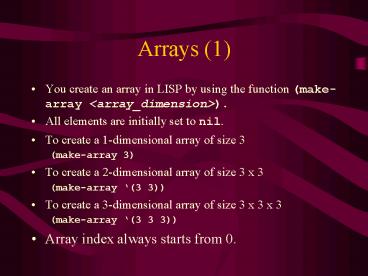
- You create an array in LISP by using the function
(make-array ltarray_dimensiongt). - All elements are initially set to nil.
- To create a 1-dimensional array of size 3
- (make-array 3)
- To create a 2-dimensional array of size 3 x 3
- (make-array (3 3))
- To create a 3-dimensional array of size 3 x 3 x 3
- (make-array (3 3 3))
- Array index always starts from 0.
2
Arrays (2)
- In the previous examples, after you have created
the arrays, there was no way by which you could
refer to it. - Here is how you can assign an array to a
variable - (setq an_array (make-array 3))
- How would you then set and access the values of
each cell within an array?
3
Aref
- To access a particular element in an array, use a
function called aref. - For example, if you have a 1 dimensional array
named an_array 10 elements, then to access the
nth element, you could do this - (aref an_array n)
- For example (aref an_array 9)
- (aref an_array 7)
4
Setf
- Setf is the only way to set the elements of an
array. - To set the nth element of an_array to a
particular value, do as follows - (setf (aref an_array n) value)
- For example (setf (aref an_array 5) Hello)
5
Incf (an interesting function?)
- Incf reads a NUMBER from an array at a specified
position, increments it, and then writes it back.
- Assume an_array (hello NIL 3)
- Then (incf (aref an_array 2)) will give you
(hello NIL 4) - What happens if you do this
- (incf (aref an_array 0))
- (incf (aref an_array 1))
Recommended

